



By Sanika PrabhuUpdated 8 min read
How to Choose the Best Online Trading Platform: A Complete Guide to Futures, ETFs, and Broker Selection
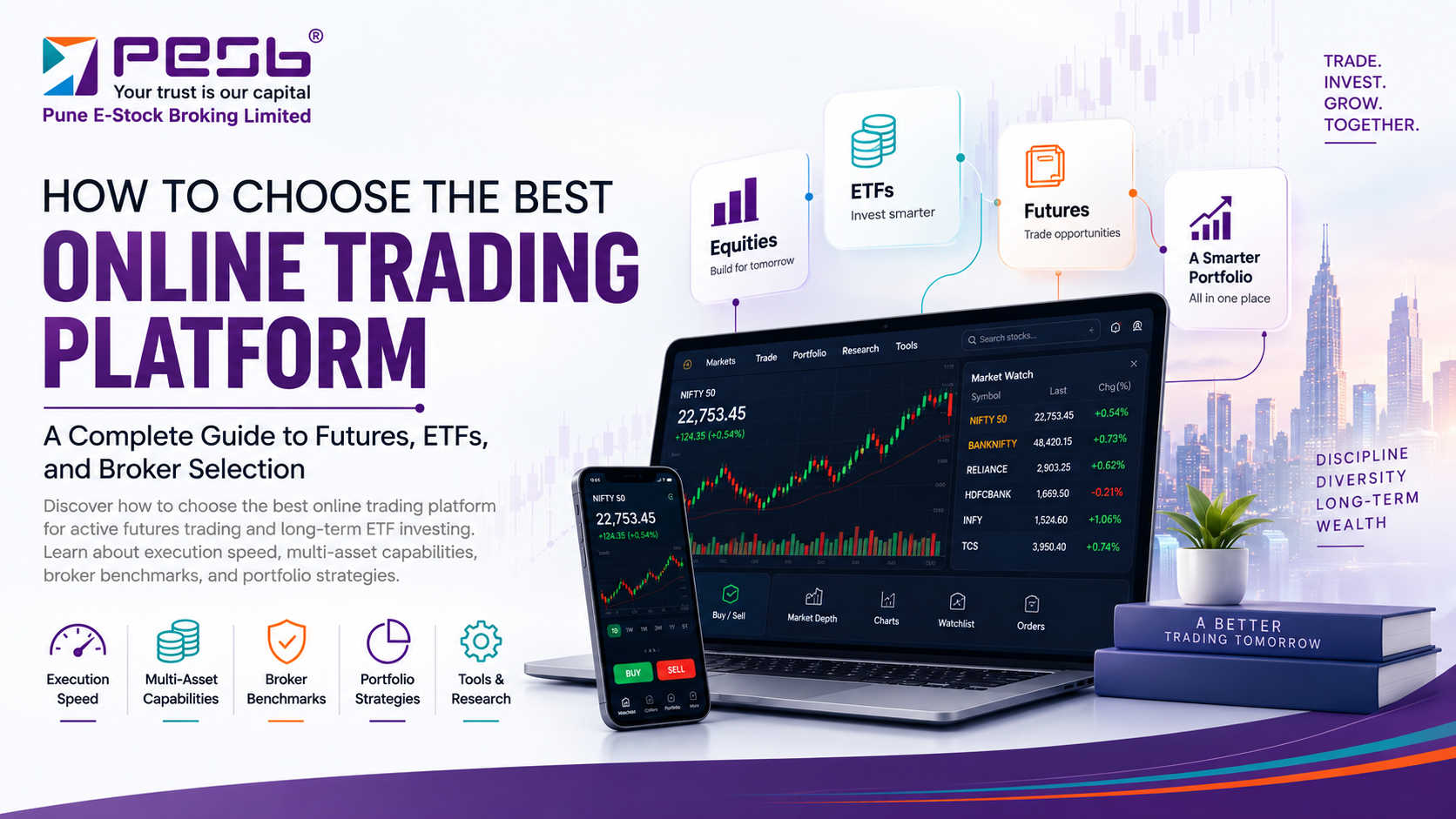
How to Choose the Best Online Trading Platform: A Complete Guide to Futures, ETFs, and Broker Selection
The global capital markets have undergone a profound digital transformation over the past decade. Modern market participants no longer rely on manual phone calls or fragmented terminals to manage their capital; instead, they operate in an interconnected ecosystem powered by high-speed execution engines, algorithmic order routing, and real-time analytical suites. Whether your objective is day-trading derivatives contracts or building a multi-decade retirement nest egg, choosing the best online trading platform is one of the most consequential financial decisions you will make.
A top-tier trading environment does not simply place trades—it serves as the nerve center for your market intelligence, risk management, asset allocation, and order execution. However, with hundreds of brokerages vying for attention, determining which provider represents the best platform for online trading requires looking past surface-level marketing. Active derivative traders need institutional-grade latency and deep order books, while wealth builders require cost-effective access to index funds and structured assets.
In this comprehensive guide, we examine what defines the best online broker trading platform, explore the mechanics of derivatives via specialized futures systems, demystify the strategic value of an ETF investment, and evaluate the features that separate ordinary trading apps from industry-leading financial hubs.
Core Pillars of the Best Online Trading Platform
When evaluating what makes an online trading best platform, experienced traders and long-term investors prioritize infrastructure, reliability, and usability over flashy user interfaces. The ideal portal harmonizes cutting-edge execution technology with comprehensive analytical tools.
1. High-Speed Order Routing and Execution Quality
In dynamic financial markets, execution speed directly influences your bottom line. Slippage—the difference between your expected price and the execution price—can rapidly erode returns, particularly in volatile market sessions. A high-performance trading platform leverages smart order routing mechanisms, direct market data feeds, and low-latency exchange connectivity across equity and commodity segments.
2. Comprehensive Charting and Technical Toolkits
Technical analysts rely on responsive, multi-timeframe charting packages equipped with standard indicators (Moving Averages, RSI, MACD, Bollinger Bands) alongside advanced tools like Fibonacci retracements, Volume Profile, and market depth (Level 2 data). The best trading online platform allows traders to execute orders directly from charts with one-click trading capabilities.
3. Regulatory Rigor and Account Security
Security is non-negotiable. Leading brokerages operate under strict regulatory compliance frameworks, holding registrations with primary market regulators (such as SEBI in India or FINRA/SIPC in international jurisdictions). Two-factor authentication (2FA), biometric logins, 256-bit encryption, and segregated client funds represent the minimum baseline for safeguarding user capital.
4. Multi-Asset Class Coverage
A truly unified platform allows you to manage cash equities, derivatives, commodities, exchange-traded funds, and mutual funds from a single dashboard. Managing your holistic portfolio under one roof streamlines collateral management, margin utilization, and tax reporting.
Navigating Active Derivatives: Choosing a Futures Online Trading Platform
For active market participants, equity and commodity derivatives represent powerful instruments for hedging portfolios, speculating on directional momentum, and capturing intraday volatility. However, derivative contracts involve leverage, meaning your trading infrastructure must provide pinpoint precision.
A dedicated futures online trading platform must fulfill several strict criteria:
Real-Time Margin Calculations
Because futures trading relies on initial and maintenance margins, your portal must provide real-time visibility into margin requirements, span margin benefits for hedged positions, and intraday exposure limits. Clear, automated margin tracking protects traders from unexpected margin calls or forced liquidations.
Advanced Order Types
Standard market and limit orders are rarely sufficient for professional derivatives strategies. The best platforms support:
- Bracket Orders (BO): Combining entry, target profit, and stop-loss orders in a single workflow.
- Cover Orders (CO): Integrating a compulsory stop-loss to maximize intraday leverage safely.
- Trailing Stop-Loss Orders: Locking in paper profits as the underlying contract moves in your favor.
- Good-'Til-Triggered (GTT) / Good-'Til-Cancelled (GTC): Retaining multi-day triggers without requiring daily manual input.
Deep Liquidity and Fast Contract Rollovers
Navigating monthly or quarterly derivative expirations requires intuitive rollover tools. A capable derivatives platform lets you transition open positions across contract expiries seamlessly, minimizing transaction friction and basis risk.
The Strategic Power of an ETF as Investment
While active traders leverage futures for short-term opportunities, long-term wealth creators increasingly recognize the ETF as investment vehicle of choice. An Exchange-Traded Fund (ETF) pools capital from multiple investors to track an underlying index, commodity, sector, or custom basket of assets while trading on stock exchanges just like individual shares.
Using an ETF in investment strategies offers several structural advantages over traditional financial products:
1. Instant Diversification with Low Expense Ratios
Investing in a broad-market index ETF—such as one tracking the Nifty 50, S&P 500, or Sensex—instantly distributes your risk across dozens of top-performing companies. Rather than picking individual stock winners, an investment in ETF vehicles allows you to capture the aggregate economic growth of an entire economy. Because most ETFs are passively managed, their expense ratios are significantly lower than actively managed mutual funds.
2. Intraday Liquidity and Pricing Transparency
Unlike traditional mutual funds, which settle only once per day at the closing Net Asset Value (NAV), an investment ETF trades continuously throughout market hours. This allows investors to execute limit orders, utilize stop-losses, or deploy tactical allocation shifts in real time.
3. Sector, Commodity, and Thematic Exposure
Beyond broad indices, modern exchange-traded products cover specialized themes:
- Commodity ETFs: Gaining direct exposure to physical gold or silver without storage overhead.
- Sector ETFs: Targeting specific high-growth sectors such as Banking, Information Technology, Healthcare, or Infrastructure.
- Debt and Liquid ETFs: Parking short-term cash efficiently while earning market-aligned yields.
| Feature | Exchange-Traded Fund (ETF) | Traditional Mutual Fund | Individual Equities |
|---|---|---|---|
| Trading Mechanism | Intraday on exchange | End-of-day NAV settlement | Intraday on exchange |
| Expense Ratios | Ultra-low (typically 0.05% - 0.50%) | Moderate to high (1.00% - 2.25%) | Zero ongoing fund fees |
| Diversification | High (baskets of 30–500+ securities) | High (professionally picked) | Low (concentrated stock risk) |
| Transparency | Real-time holdings disclosure | Monthly / periodic portfolio disclosure | Direct individual ownership |
Incorporating disciplined ETF investment strategies through Systematic Investment Plans (SIPs) or lump-sum allocations provides the bedrock for durable portfolio compounding.
Global Benchmarks vs. Full-Service Modern Broking
When investors research international market leaders, names like the Fidelity online trading platform and the Charles Schwab online trading platform frequently emerge as gold standards for retail accessibility, wealth planning interfaces, and deep institutional research.
The schwab online trading platform (including its renowned thinkorswim suite) and Fidelity's ecosystem are celebrated worldwide for combining self-directed execution tools with extensive retirement planning modules, educational libraries, and dedicated client service. They proved that modern investors need not choose between sophisticated digital tools and human advisory support.
In the Indian capital markets, corporate broking institutions have embraced a similar philosophy. For over 17 years, Pune E Stock Broking Limited (PESB) has empowered retail and institutional participants by blending institutional-grade order execution technology with in-depth research analytics and personalized customer guidance. As an exchange member across NSE, BSE, MCX, and NCDEX, and a SEBI-registered Research Analyst, PESB exemplifies how modern full-service broking provides traders with localized expertise, direct phone support, and comprehensive investment products spanning Equities, Futures, Commodities, and ETFs.
Essential Checklist: How to Select Your Online Trading Platform
To identify the online trading platform best suited for your specific objectives, evaluate prospective brokers against this practical checklist:
[ ] Regulatory Status: Is the broker fully licensed and registered with primary financial authorities?
[ ] Pricing Structure: Are brokerage charges, DP fees, and statutory taxes transparently disclosed?
[ ] Platform Stability: Does the software maintain uptime during peak market opening and volatility events?
[ ] Asset Breadth: Can you trade Equities, Derivatives, Commodities, and ETFs from a single account?
[ ] Research Quality: Does the broker provide actionable, data-driven fundamental and technical research?
[ ] Execution Latency: Is order routing instantaneous with minimal slippage?
[ ] Customer Support: Is personalized human assistance accessible when technical or operational questions arise?
Balancing Low Cost with Research and Human Support
While ultra-discount brokers focus purely on basic order placement, full-service broking houses deliver independent research, relationship management, and customized portfolio guidance. For beginners and sophisticated traders alike, having direct access to experienced market professionals can prevent costly mistakes during market turbulence.
Building a Synergistic Portfolio Strategy
The most resilient market participants do not restrict themselves to a single style. Instead, they construct a "Core and Satellite" portfolio architecture:
- The Core (Long-Term Growth): 60% to 80% of capital allocated to passive index and sector ETF investment, generating stable compounding over multi-year horizons with minimal maintenance.
- The Satellite (Active Alpha): 20% to 40% of capital utilized on a specialized futures online trading platform or selective equity opportunities to capture swing trends, hedge macroeconomic downturns, and generate active cash flow.
By executing this integrated approach through a stable, feature-rich broking platform, investors achieve optimal capital efficiency while strictly managing downside risk.
Conclusion: Elevate Your Trading and Investing Journey
Whether you are executing rapid-fire derivative strategies or building generational wealth through index and thematic ETFs, your success in the capital markets is closely tied to the platform and partner you choose. The best online broker trading platform is one that delivers blazing execution speeds, rock-solid security, comprehensive multi-asset access, and the backing of seasoned market research.
Ready to elevate your market experience with cutting-edge technology and 17+ years of trusted financial expertise? Connect with the PESB advisory and support team today to open your account and take command of your financial future.
Related resources
- futures online trading platform
- best online trading platform
- best online broker trading platform
- best platform for online trading
- best trading online platform
- online trading best platform
This article is for information and education only and is not investment advice. Investments in securities market are subject to market risks; read all related documents carefully before investing.


