



By Sanika PrabhuUpdated 9 min read
The Complete Guide to Choosing an Online Trading Platform: Equities, ETFs, Futures, and Long-Term Wealth Creation
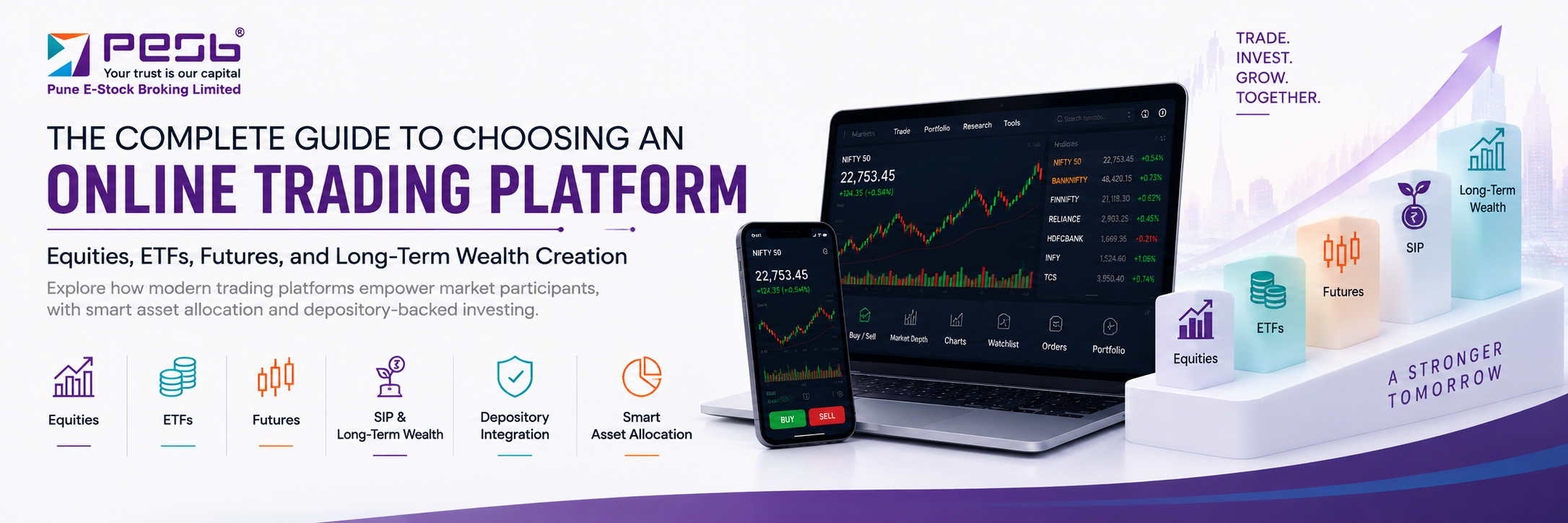
The Complete Guide to Choosing an Online Trading Platform: Equities, ETFs, Futures, and Long-Term Wealth Creation

The global capital markets have undergone a profound transformation over the past two decades. What once required frantic phone calls to floor brokers, physical paper share certificates, and manual trade settlements has shifted seamlessly into high-speed digital architecture. Today, a sophisticated online trading platform acts as the command center for millions of retail and institutional market participants across the globe.
Whether you are an intraday derivative trader executing multi-leg strategies, a disciplined professional building retirement wealth through systematic mutual funds, or an allocator evaluating exchange-traded funds (ETFs), the digital interface you select plays a pivotal role in your financial outcomes. Navigating the modern market landscape requires understanding how different asset classes operate, how technology bridges order routing, and how fundamental depository infrastructure safeguards your wealth.
The Evolution of the Online Platform for Trading
When retail investors first gained access to screen-based market terminals, digital trading was primarily viewed as a basic electronic order book. Over time, advancements in financial technology transformed the standard online platform for trading into an integrated ecosystem featuring real-time tick-by-tick market feeds, algorithmic execution engines, interactive technical charting, and institutional-grade risk management.
A dependable platform for online trading must seamlessly deliver three core pillars:
- Low-Latency Order Routing: Executing market, limit, and stop-loss orders in milliseconds to prevent slippage during volatile trading sessions.
- Comprehensive Asset Access: Providing unified access to cash equities, index and stock derivatives, commodities, currencies, and fixed-income products.
- Intuitive Portfolio Analytics: Offering transparent tracking of capital allocation, unrealized/realized profit & loss, tax-lot accounting, margin utilization, and corporate actions.
As digital connectivity expanded across desktop software, web applications, and mobile terminals, the demand for resilient trading platform online services skyrocketed. For market participants seeking reliable trade execution paired with analytical rigor, partnering with seasoned corporate brokers like Pune E Stock Broking Limited's research and broking solutions ensures that technological speed is backed by decades of regulatory compliance, research backing, and deep market experience.
Exploring Asset Classes: Equities, Futures, and Global Currencies
Modern capital allocators rarely restrict themselves to a single security type. A well-rounded financial strategy balances active risk management with long-term capital compounding.
1. Active Derivatives and the Futures Online Trading Platform
Derivative markets, specifically futures contracts, enable market participants to hedge underlying portfolio risk or capitalize on directional price swings with leverage. When operating through a specialized futures online trading platform, speed and stability are critical.
- Hedging Portfolios: Institutional and retail investors holding large equity positions can hedge against macroeconomic downturns by shorting index futures.
- Margin Efficiency: Because futures require only an initial margin (SPAN and exposure margins) rather than the contract's total nominal value, capital efficiency is enhanced. However, this leverage amplifies both gains and losses.
- Order Types & Risk Controls: Advanced trading software offers Bracket Orders (BO), Cover Orders (CO), and trailing stop-losses to automatically protect capital against sharp market reversals.
2. Global Currency Dynamics and Forex Platforms
Currency markets reflect macroeconomic fundamentals, interest rate differentials, and global trade flows. Accessing a dedicated forex online trading platform or currency derivative segment allows businesses and individual traders to hedge foreign exchange exposure. Whether trading major cross-currency pairs or domestic exchange-traded currency derivatives, having a secure online trading platform forex framework ensures access to deep market liquidity, competitive spreads, and transparent central counterparty clearing.

Exchange-Traded Funds (ETFs): The Modern Portfolio Cornerstone
Over the past decade, the adoption of an etf as investment instrument has surged globally. An Exchange-Traded Fund pools capital to track an underlying index, commodity, bond basket, or sector, combining the diversification benefits of a mutual fund with the intraday liquidity of common stocks.
Key Advantages of an ETF in Investment Portfolios
- Cost Efficiency: ETFs generally feature lower expense ratios compared to actively managed mutual funds because they mirror established benchmark indices.
- Real-Time Intraday Pricing: Unlike mutual funds where net asset value (NAV) is computed solely at the end of the trading day, ETFs trade throughout regular exchange hours.
- Instant Diversification: Buying a single unit of a broad-market index ETF gives immediate exposure to dozens or hundreds of top-tier underlying companies, reducing single-stock concentration risk.
- Asset Flexibility: Investors can allocate across equity indices, government debt, gold, silver, and thematic sectors.
Global ETF Ecosystems: Learning from International Models
Looking at global asset managers provides valuable perspective on fund structure and passive investing. For instance, global giants like Fidelity have demonstrated the power of passive indexing through solutions like fidelity investment etf offerings and integrated platforms such as the fidelity online trading platform. These international benchmarks illustrate how low-cost index tracking, transparent holdings disclosure, and robust execution tools encourage long-term retail participation.
Whether investing domestically in benchmark index funds or exploring global fund allocations, integrating an etf in investment frameworks provides steady beta exposure while minimizing portfolio turnover costs.
Disciplined Wealth Accumulation: Mutual Funds & SIP Planning
While active traders leverage volatile market movements, long-term wealth creation for most individuals is driven by consistency, time in the market, and the power of compounding. Systematic Investment Plans (SIPs) in mutual funds and index funds remain one of the most effective tools for beating inflation.
How Rupee Cost Averaging Works
Instead of attempting to time market peaks and troughs—a strategy that often leads to emotional mistakes—a Systematic Investment Plan allocates a fixed sum of money at predetermined intervals (e.g., monthly).
- When market valuations dip, your fixed contribution purchases a larger number of mutual fund or ETF units.
- When valuations rise, your installment purchases fewer units at a higher price.
- Over a multi-year horizon, this mechanism smooths out purchase costs and eliminates emotional biases from investing.
Leveraging a SIP Investment Plans Calculator
Before initiating a systematic plan, utilizing a sip investment plans calculator helps investors visualize the mathematical trajectory of their capital. By adjusting key inputs—monthly investment amount, expected annual rate of return, and investment duration—you can project the compounded future value of your portfolio.
Illustrative SIP Growth Scenario
| Monthly Investment | Investment Horizon | Assumed Annual Return | Total Capital Invested | Estimated Maturity Value |
|---|---|---|---|---|
| ₹5,000 | 10 Years | 12% | ₹6,00,000 | ~₹11,61,695 |
| ₹10,000 | 15 Years | 12% | ₹18,00,000 | ~₹50,45,760 |
| ₹20,000 | 20 Years | 12% | ₹48,00,000 | ~₹1,99,82,960 |
Note: The figures above are for illustrative and educational purposes. Actual market returns fluctuate based on market cycles, macroeconomic factors, and asset selection.
A structured calculator demonstrates that the true driver of exponential wealth is not an unrealistic pursuit of high-risk speculative returns, but rather the compounding duration of disciplined contributions.
Market Infrastructure: The Vital Role of Depositories and CDSL
To trade and invest with complete peace of mind, market participants rely on an interconnected financial architecture consisting of stock exchanges, clearing corporations, broking houses, and central depositories.
In India, electronic securities are safeguarded by two primary depositories: the Central Depository Services (India) Limited (CDSL) and the National Securities Depository Limited (NSDL). When you purchase shares or ETF units through a regulated broking house, the shares do not reside on the broker's balance sheet; they are credited directly into your electronic Demat account maintained with the depository.
Understanding Depository Operations and Market Valuation
As retail participation in financial markets has scaled rapidly, depositories have experienced tremendous operational growth. Investors often track listed infrastructure entities; for instance, the central depository services share price reflects public market sentiment regarding retail trading volumes, new Demat account additions, and corporate action processing revenues.
As a registered CDSL Depository Participant (DP ID: IN-DP-479-2020), Pune E Stock Broking Limited ensures that your dematerialized assets, pledging requirements, and corporate benefits (such as bonus shares and dividends) are maintained with uncompromising security and regulatory compliance.
Key Evaluation Checklist: Selecting the Best Platform for Online Trading
When evaluating an online platform trading solution, consider the following critical checklist:
1. Robust Security and Regulatory Credentials
Ensure your broker is directly registered with financial market regulators (such as SEBI), holds memberships with premier exchanges (NSE, BSE, MCX), and operates under clean compliance records. Look for multi-factor authentication (MFA), biometric mobile logins, and encrypted data transmission.
2. High-Speed Architecture & Reliability
During major macroeconomic events—such as budget announcements, interest rate decisions, or corporate earnings releases—trading volume surges dramatically. Your trading platform online must maintain high uptime and sub-second order processing without server freezes.
3. Integrated Research & In-Depth Analytics
Technical screeners, advanced charting (with indicators like VWAP, Supertrend, RSI, and MACD), depth-of-market feeds (Level 2/Level 3 data), and fundamental equity research notes empower you to execute trades based on data rather than rumors.
4. Dedicated Human Support and Transparent Pricing
Automated chatbots can only solve surface-level queries. When navigating complex settlement questions, Demat transfers, or margin obligations, having access to an experienced dealer desk and back-office team makes all the difference.
Practical Framework for Portfolio Construction
A balanced approach combines tactical trading and strategic investing within a coherent framework:
                                [TOTAL PORTFOLIO]
                                        |
            +---------------------------+---------------------------+
            |                                                       |
   [CORE PORTFOLIO (70-80%)]                               [TACTICAL SLEEVE (20-30%)]
            |
  +---------+---------+                                   +---------+---------+
  |                   |                                   |                   |
[Broad Market       [Disciplined                        [Active Futures     [Short-Term
 ETFs & Equities]    SIPs in Funds]                      & Hedging]          Momentum Swings]
- Core Allocation (70–80%): Low-cost index ETFs, blue-chip equities, and systematic SIP investments in mutual funds designed for long-term compounding.
- Tactical Sleeve (20–30%): Short-term positional swing trades, futures hedging, or sector rotation strategies managed via a high-speed online platform for trading.
Conclusion: Empowering Your Market Journey
Participating in capital markets successfully requires more than just picking stocks; it demands a disciplined mindset, an understanding of market mechanics, and a dependable technological bridge. From utilizing a sip investment plans calculator for long-term goal setting to managing risk on a high-speed futures online trading platform, your chosen broker serves as your primary gateway to financial freedom.
For over 17 years, PUNE e STOCK BROKING LIMITED (PESB) has combined cutting-edge order routing technology with institutional-grade research, serving over 75,000 clients across India. Whether you are beginning your investment journey or seeking a powerful platform for active derivatives trading, our dedicated specialists are here to guide you.
Ready to elevate your trading and investment experience? Connect with our dedicated financial support team today to open your account and discover the difference that technology, integrity, and market expertise can make in your financial journey.
Related resources
- online trading platform
- online platform for trading
- futures online trading platform
- platform for online trading
- trading platform online
- online platform trading
This article is for information and education only and is not investment advice. Investments in securities market are subject to market risks; read all related documents carefully before investing.


