



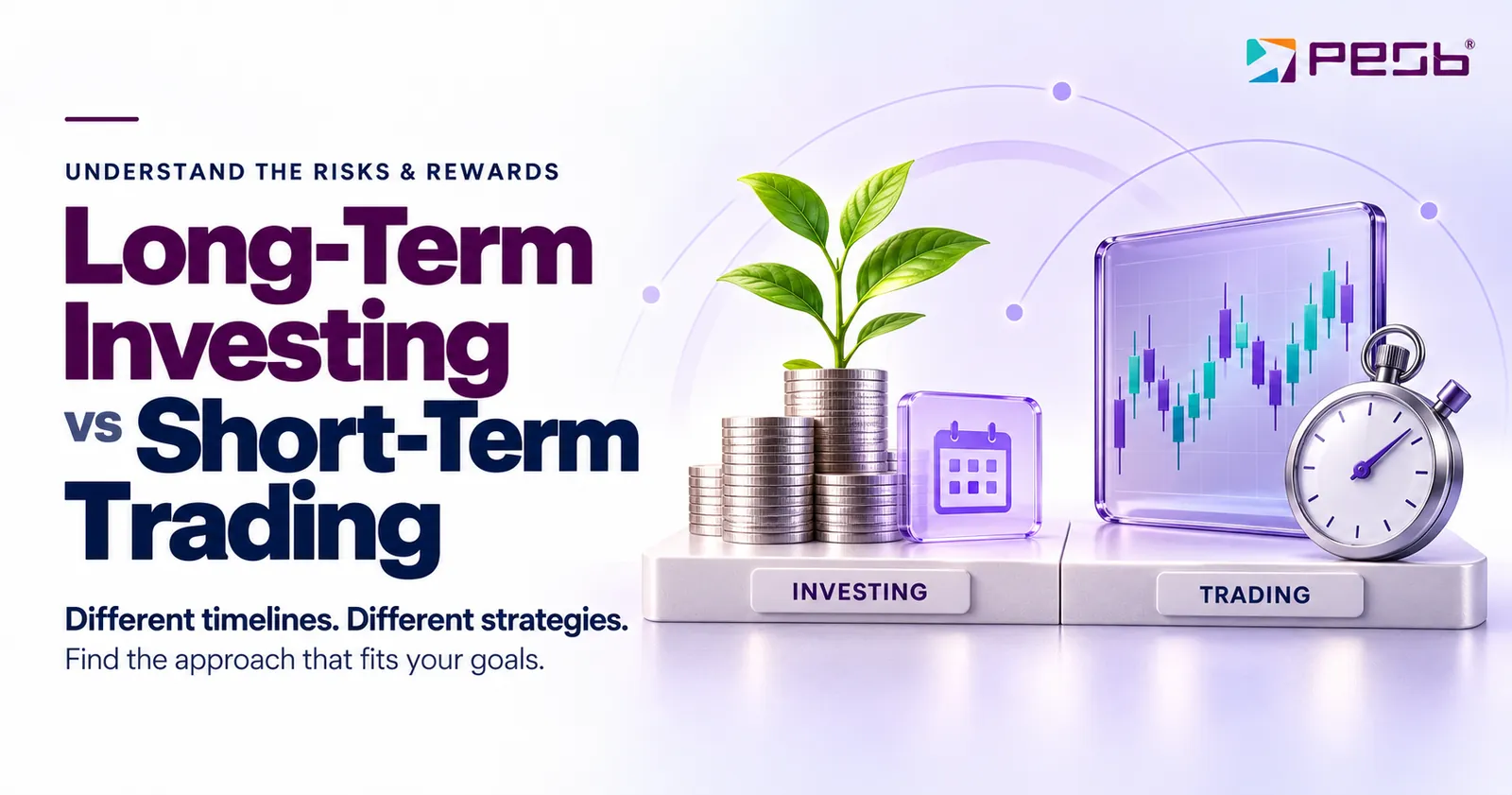
The surge of digital brokerage accounts and high-speed execution tools has democratized access to financial markets. Today, any individual with a smartphone can participate in stock exchanges, allocating capital across equities, index funds, and derivatives. However, ease of access often blurs the line between two fundamentally distinct financial disciplines: long-term investing and short-term active trading.
While market commentary frequently treats these approaches interchangeably under the broad umbrella of "market participation," their mechanics, risk profiles, capital requirements, and psychological demands operate on opposing principles. Recent regulatory studies, particularly data released by the Securities and Exchange Board of India (SEBI), have brought renewed scrutiny to retail market outcomes, emphasizing the divergent realities faced by wealth builders and speculative traders.
Evaluating the structural differences between investing and trading enables participants to choose strategies aligned with their financial goals, analytical skill sets, and emotional temperament.
Time Horizons and the Compounding Engine
The most visible differentiator between investing and trading is the operational time horizon.
Long-Term Investing Horizons (3 to 10+ Years)
Long-term equity investing aligns with the underlying economic lifecycle of businesses. When an investor purchases shares of a listed enterprise, they commit capital to participate in corporate earnings growth, product cycles, and industry expansion. The typical holding period spans multiple years or decades.
Over an extended horizon, short-term price fluctuations—often referred to as "market noise"—diminish in significance relative to business fundamentals. Long-term wealth creation relies heavily on the mathematical principle of compounding returns, where dividend reinvestment and reinvested retained earnings drive geometric capital expansion over time.
Short-Term Trading Horizons (Intraday to Weeks)
Trading operates across compressed intervals: seconds, minutes, hours, or days. Intraday traders close positions before market close to eliminate overnight gap risk, while swing traders hold positions for several days or weeks to capture anticipated price swings.
Because short-term traders do not hold assets long enough to benefit from intrinsic business growth, their returns depend strictly on pricing inefficiencies, immediate supply-demand imbalances, and volatility momentum. Compounding in trading is achieved through rapid turnover of trading capital rather than structural business growth.
Analytical Approaches: Fundamental vs. Technical Analysis
How market participants evaluate securities dictates their research processes, information sources, and decision frameworks.
Analytical framework comparison:
- Long-term investing (business ownership): fundamental analysis of balance sheet health, ROCE, free cash flow, competitive moats and long-term macroeconomic tailwinds.
- Short-term trading (price speculation): technical analysis of price action, support and resistance, chart patterns, momentum indicators, order book depth and market microstructure.
Fundamental Analysis in Equity Investing
Investors evaluate securities through corporate balance sheets, cash flow statements, and income reports. Key variables include:
- Return on Capital Employed (ROCE) and Return on Equity (ROE): Measuring capital allocation efficiency.
- Free Cash Flow (FCF): Gauging cash generation after capital expenditures.
- Competitive Moat: Identifying durable pricing power, brand equity, or technological advantages.
- Management Governance: Assessing capital allocation track records and transparency.
For investors seeking broad market exposure without individual security selection, utilizing an etf investment strategy serves as an efficient vehicle. Selecting an etf as investment provides diversified exposure across indexes, sectors, or thematic baskets. Choosing an investment in etf structures eliminates single-stock idiosyncratic risk while capturing macroeconomic expansion.
Technical Analysis and Microstructure in Active Trading
Traders bypass corporate balance sheets in favor of price action, liquidity indicators, and volume metrics. Their analytical toolkit includes:
- Moving Averages and Oscillators: Identifying directional bias and overbought or oversold extremes (e.g., RSI, MACD).
- Support and Resistance Levels: Locating high-probability zones where institutional supply and demand congregate.
- Order Flow and Depth: Tracking market depth (Level 2 data) and volume-weighted average price (VWAP).
When trading high-velocity instruments, market participants rely on specialized infrastructure, selecting a responsive futures online trading platform to execute complex derivatives contracts with millisecond precision.
The Reality of Retail Derivatives: SEBI Participation Data
Discussions regarding active retail trading require empirical examination. In recent comprehensive studies published by the Securities and Exchange Board of India (SEBI), regulatory analysts tracked retail participation across equity derivative segments (Futures & Options).
SEBI retail derivatives participation study at a glance:
- Retail loss rate: according to SEBI, 87.7% of individual traders incurred net losses.
- Total net losses: over ₹916 billion in aggregate net losses in FY26, according to SEBI.
- Trader churn: about 4.6 million participants exited the segment.
- Key factors: transaction costs, slippage, unhedged leverage, psychological overtrading and no stop-loss discipline.
The SEBI findings revealed that 87.7% of individual traders incurred net financial losses in the derivatives market, with aggregate losses exceeding hundreds of billions of rupees annually. Furthermore, millions of retail participants exited the segment yearly due to rapid capital depletion.
Several structural factors explain why short-term active trading presents severe headwinds for individual participants:
- Zero-Sum Mechanics (Negative-Sum After Costs): While long-term equity investing is a positive-sum game driven by aggregate economic expansion, trading derivatives is structurally zero-sum. After accounting for exchange transaction fees, securities transaction taxes (STT), brokerage charges, and bid-ask slippage, active trading becomes net-negative for retail participants.
- Leverage Asymmetry: Derivatives enable high leverage, amplifying downside risk. Unanticipated gap openings frequently liquidate undercapitalized accounts before corrective action can be taken.
- Institutional Dominance: Retail traders compete directly against algorithmic market makers, co-located institutional servers, and statistical arbitrage desks equipped with advanced analytical toolsets.
These findings highlight the importance of disciplined capital management and underscore why sustainable wealth accumulation for the vast majority of market participants is grounded in asset-backed investing rather than hyper-active speculation.
Risk Management and Capital Allocation Strategies
Preserving capital is the primary objective of any financial participant. However, risk management techniques differ fundamentally between investors and traders.
Asset Allocation and Diversification in Investing
For the long-term wealth builder, risk management is achieved prior to entry through position sizing and asset diversification:
- Core-and-Satellite Strategy: Allocating 70–80% of capital to diversified broad-market equity funds or an established investment etf, while dedicating the remaining 20–30% to high-conviction individual stocks.
- Periodic Rebalancing: Periodically selling outperforming asset classes to acquire undervalued assets, maintaining target risk exposures across equities, fixed income, and commodities.
- Dollar-Cost Averaging (SIP): Systematic investments spread across market cycles reduce the impact of timing risk, converting volatility into an accumulation advantage.
Through structured research from seasoned market analysts, such as the expert equity research and broking services offered by established broking houses, investors can construct resilient multi-cap portfolios tailored to long-term objectives.
Position Sizing and Capital Preservation in Trading
For active traders, risk management is dynamic, executed while positions are live:
- The 1% Risk Rule: Never risking more than 1% to 2% of total trading account equity on a single setup.
- Hard Stop-Loss Orders: Predetermined price exits that execute automatically when a thesis is invalidated, preventing catastrophic drawdown.
- Risk-to-Reward Ratio (R:R): Structuring setups to achieve at least a 1:2 or 1:3 reward-to-risk ratio, ensuring long-term mathematical expectancy even with a 40–50% win rate.
Investor Psychology and Behavioral Pitfalls
Human cognitive biases impact financial decision-making across all time horizons, but they manifest differently in investing and trading.
Psychological biases and pitfalls:
- Long-term investing challenges: loss aversion, herd mentality, action bias, market timing paralysis and recency bias.
- Short-term trading challenges: revenge trading, FOMO, the gambler's fallacy, tilt or emotional fatigue, and overconfidence.
Psychological Demands of Investing
- Patience and Inaction: The hardest part of investing is often doing nothing during market corrections. When macroeconomic headlines trigger fear, investors must resist the impulse to panic-sell fundamentally sound businesses.
- Combating Loss Aversion: Research shows financial losses feel twice as painful as equivalent gains feel pleasurable. Successful investors accept temporary paper drawdowns as the price of admission for long-term equity returns.
Psychological Demands of Active Trading
- Emotional Detachment: Traders must execute dozens of decisions weekly without allowing previous wins or losses to dictate upcoming trades.
- Combating Revenge Trading: Experiencing consecutive losses often triggers irrational urges to recover capital quickly by increasing position size or abandoning strict trading rules—a leading driver of retail account wipeouts.
- Cognitive Stamina: Staring at intraday tick charts creates psychological fatigue, leading to degraded executive function and poor risk adherence.
Platform Infrastructure and Technology Selection
Whether executing periodic systematic investments or navigating rapid intraday momentum, the quality of your digital trading infrastructure plays a vital operational role.
Platform Needs for Long-Term Investors
Investors prioritizing an etf in investment framework or equity portfolio construction require platforms focused on:
- Comprehensive fundamental research tools, financial statement visualization, and consensus estimates.
- Automated systematic investment plan (SIP) execution and corporate action tracking (dividends, bonus shares, rights issues).
- Transparent cost reporting, depository participant (CDSL/NSDL) integration, and seamless tax-loss harvesting reports.
In global markets, institutional platforms like the fidelity online trading platform and the schwab online trading platform (developed via the charles schwab online trading platform ecosystem) have established standards for comprehensive research access, broad mutual fund integration, and retirement portfolio tooling.
Platform Needs for Active Traders
Traders seeking the best online trading platform for short-term operations need high-performance features:
- Ultra-low latency order routing and direct market access (DMA).
- Advanced charting packages with integrated technical indicators, tick charts, and multi-timeframe analysis.
- Algorithmic and bracket order capabilities (OCO, trailing stop-losses, trigger orders).
- Reliable uptime during periods of extreme market volatility and high trading volume.
Identifying the best online broker trading platform depends entirely on whether a user's strategy demands analytical research depth or sub-second order execution speed. Selecting the best platform for online trading requires evaluating regulatory compliance, data security, transparent fee structures, and responsive dealer support.
Direct Comparative Summary: Investing vs. Trading
To synthesize the two approaches, the comparison below highlights the operational trade-offs across essential dimensions:
- Primary Objective: Investing: Long-term capital appreciation & wealth compounding. Trading: Capturing short-term price volatility & cash flow.
- Holding Period: Investing: Multi-year (3 to 10+ years). Trading: Minutes, hours, days, or weeks.
- Core Analytical Basis: Investing: Fundamental analysis & macroeconomic trends. Trading: Technical analysis, price action, & order flow.
- Return Mechanism: Investing: Business earnings growth & dividend yields. Trading: Market pricing inefficiencies & momentum.
- Instrument Types: Investing: Cash equities, index funds, thematic ETFs. Trading: Equities, futures, options, leveraged derivatives.
- Market Dynamics: Investing: Positive-sum (grows with economy). Trading: Negative-sum after commissions, taxes, & slippage.
- Time Commitment: Investing: Low to moderate (periodic review & rebalancing). Trading: High (continuous screen time during market hours).
- Psychological Demand: Investing: Patience, long-term discipline, tolerance for volatility. Trading: High emotional regulation, fast execution, loss acceptance.
Choosing Your Strategy: A Balanced Perspective
Financial market participation is not an all-or-nothing proposition. Many seasoned market participants adopt a structured hybrid approach:
- Core Wealth Portfolio: Dedicating 80% to 90% of investable net worth to long-term diversified equity holdings, debt instruments, and ETF assets that compound steadily over time.
- Tactical Trading Allocation: Allocating a strict 10% to 20% of discretionary risk capital to active trading strategies, governed by uncompromising stop-loss rules and independent risk parameters.
This separation protects long-term family security and retirement milestones from the statistical risks inherent in short-term trading, while allowing active participants to pursue market-driven trading opportunities.
Whether your objective is building a multi-decade investment portfolio or establishing high-performance trading capabilities, working with a well-regulated, technologically advanced broker provides the foundation for sustainable execution. For tailored guidance, research insights, and depository assistance, contact our dedicated advisory team at PESB to align your market strategies with institutional-grade support.
Related resources
- schwab online trading platform
- futures online trading platform
- fidelity online trading platform
- etf as investment
- etf in investment
- etf investment
This article is for information and education only and is not investment advice. Investments in securities market are subject to market risks; read all related documents carefully before investing.


