


Market EducationInvesting BasicsBy Sheilandra Singh11 min read
Equity, Commodity and Currency Markets: A Beginner's Guide for India
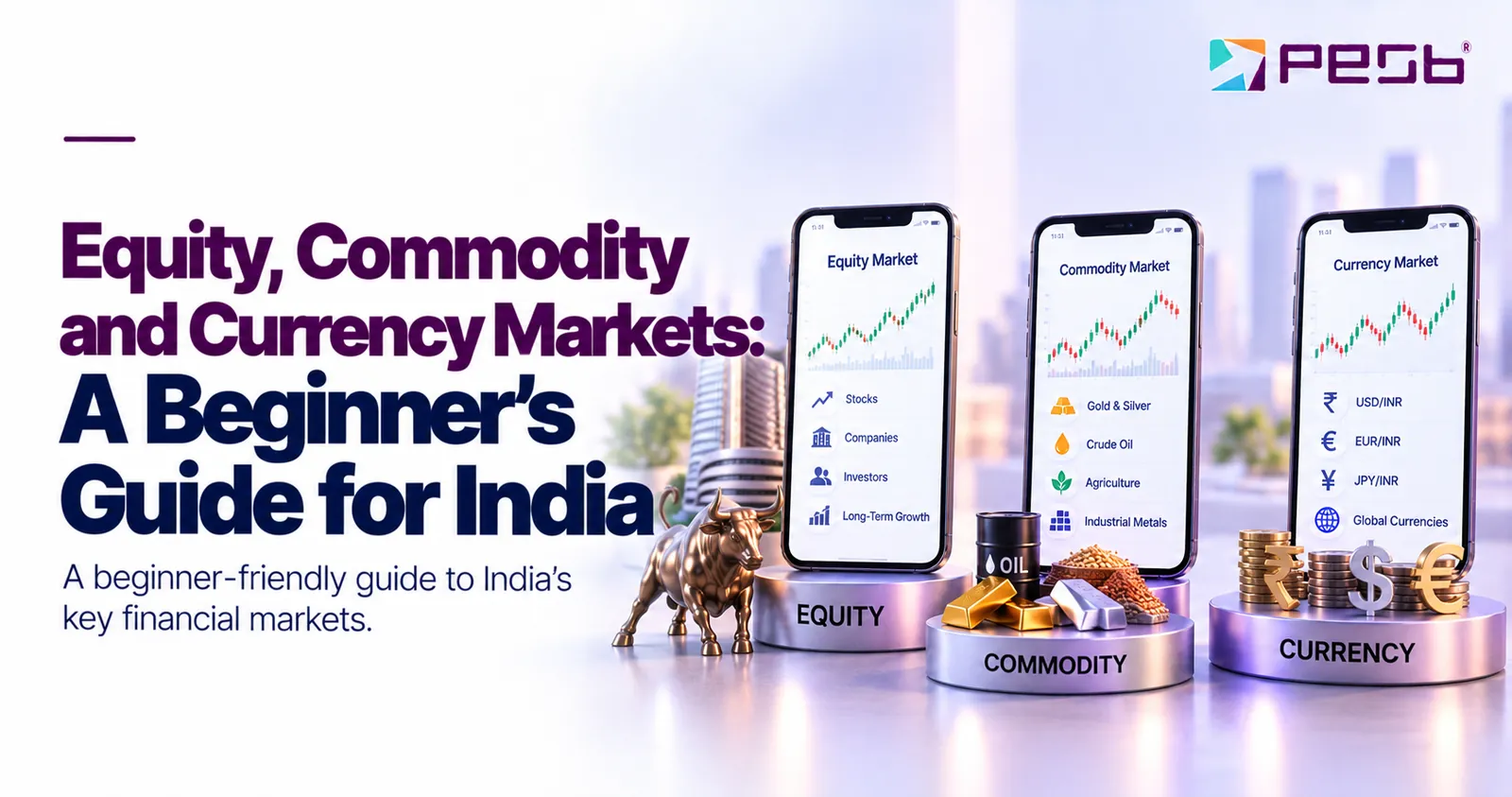
Many new investors open a trading account thinking only of shares, then hear terms like gold futures on MCX or USD-INR contracts and feel lost. Indian retail investors can access three distinct marketplaces, and the equity, commodity and currency markets each have their own products, participants and price drivers. This guide explains all three in plain language, so you can understand what each one does before you put money to work.
Key takeaways
- Equity markets trade company shares and related derivatives on exchanges like NSE and BSE.
- Commodity markets trade futures and options on metals, energy and farm products on MCX and NCDEX.
- Currency markets trade futures and options on exchange rates like USD-INR in the currency segments of the stock exchanges.
- All three markets are regulated by the Securities and Exchange Board of India (SEBI), and each responds to different forces, from company earnings to monsoon rains to central bank policy.
- A broker with NSE and BSE equity membership plus MCX and NCDEX commodity membership lets you reach multiple markets from one account.
What are equity, commodity and currency markets?
Equity, commodity and currency markets are three separate marketplaces where different assets change hands. The equity market trades ownership stakes in companies. The commodity market trades contracts on physical goods like gold and crude oil. The currency market trades contracts on exchange rates, such as the rupee against the US dollar.
All three operate through organised exchanges that match buyers and sellers. The rules come from SEBI, India's capital markets regulator. SEBI has regulated commodity markets since 2015, when the Forward Markets Commission was merged into it (Source: SEBI, 2015). Although the assets differ, the basic idea is the same everywhere. Prices move based on supply, demand and expectations about the future.
Why does SEBI regulation matter to a beginner? It means every market described in this guide answers to one watchdog with a clear job. The law that created SEBI states that job directly.
"To protect the interests of investors in securities and to promote the development of, and to regulate the securities market." (Preamble, SEBI Act, 1992)
Share on LinkedIn · Share on X
For a retail investor, the practical difference between markets shows up in three places. These are what you buy, why prices move, and how much risk each product carries. The sections below walk through each market in turn.
What does the equity market trade, and who participates?
The equity market trades shares, which represent part ownership of a listed company. It also trades products built on those shares, such as futures, options and exchange traded funds (ETFs). In India, equity trading happens mainly on the National Stock Exchange (NSE) and the Bombay Stock Exchange (BSE).
BSE traces its origins to 1875 and describes itself as Asia's oldest stock exchange (Source: BSE, 2024). The NSE began operations in 1994. It introduced nationwide screen-based trading, which opened markets to investors far beyond Mumbai's trading floors (Source: NSE, 2024).
Participants in the equity market fall into a few broad groups:
- Retail investors: individuals buying and selling for their own accounts.
- Domestic institutions: mutual funds, insurance companies and pension funds.
- Foreign portfolio investors: overseas funds investing in Indian companies.
- Companies and promoters: firms raising capital through IPOs or buying back shares.
When you buy a share in the cash segment, you pay the full price. The share then lands in your demat account. In the derivatives segment, you trade contracts whose value comes from an underlying share or index. You use margin, which is a fraction of the contract value, instead of full payment.
Margin magnifies both gains and losses. A SEBI research study, "Analysis of Profit and Loss of Individual Traders dealing in equity F&O segment" (SEBI, January 2023), found that about nine in ten individual equity futures and options traders lost money in the period studied. That finding alone is a strong reason to learn before you trade leveraged products.
What drives share prices in the equity market?
Share prices move on a mix of company performance, economic conditions and investor sentiment. Earnings growth and management quality affect individual stocks. Interest rates, inflation and GDP data move the whole market.
A few concrete drivers to watch:
- Company results: quarterly profits that beat or miss expectations shift prices quickly.
- Interest rates: rate changes by the Reserve Bank of India (RBI) affect borrowing costs and valuations.
- Global cues: moves in US and Asian markets often set the tone for the Indian opening.
- Fund flows: heavy buying or selling by foreign and domestic institutions pushes indices up or down.
For beginners, the key lesson is simple. Equity prices reflect expectations about the future, not just current facts. That is why a company can report good profits and still see its share price fall if investors expected even better numbers.
What is commodity trading in India, and who participates?
Commodity trading in India means buying and selling futures and options contracts on physical goods through a commodity exchange. Instead of company shares, you trade contracts on gold, silver, crude oil, natural gas, cotton, spices and other products. The two main exchanges are the Multi Commodity Exchange (MCX) and the National Commodity and Derivatives Exchange (NCDEX).
MCX focuses largely on bullion, metals and energy contracts. NCDEX focuses largely on agricultural products. Most retail traders never take delivery of the physical goods. They buy and sell contracts to benefit from price moves, and they close positions before expiry.
Participants in the commodity market include:
- Hedgers: farmers, jewellers and manufacturers locking in prices to protect their business.
- Speculators: traders trying to profit from price changes.
- Arbitrageurs: participants profiting from small price gaps between markets.
- Retail investors: individuals trading smaller contracts with their own capital.
This mix is what makes the commodity market different from the equity market. A jeweller buying gold futures is managing business risk. A speculator selling the same contract has a completely different goal. Both meet on the same exchange.
What moves prices in the commodity market in India?
Commodity prices move on supply and demand for the physical goods themselves. Weather, global output, government policy and the rupee all play a role. Company earnings, which drive share prices, do not matter here at all.
Key drivers include:
- Weather and monsoon: rainfall directly affects farm output and agri commodity prices.
- Global supply: decisions by oil-producing nations move crude oil prices worldwide.
- The rupee: a weaker rupee makes imported commodities like gold and crude costlier in India.
- Government policy: import duties, export rules and minimum support prices shift agri markets.
- Festive and seasonal demand: gold demand often rises around weddings and festivals.
A practical example helps. If you are learning how to trade in the commodity market, watch how gold reacts when the rupee weakens. Even if the global gold price stays flat, the MCX gold price can rise simply because each dollar of gold costs more rupees. That link between markets is why many traders track the equity, commodity and currency markets together rather than in isolation.
What are currency derivatives in India, and who uses them?
Currency derivatives in India are futures and options contracts on exchange rates, traded in the currency segments of the stock exchanges. The most traded pair is USD-INR, the dollar against the rupee. Contracts on EUR-INR, GBP-INR and JPY-INR are also available. Currency futures were first introduced on Indian exchanges in 2008 (Source: RBI, 2008).
The users of this market fall into two camps:
- Hedgers: importers, exporters and companies with foreign income or costs. They use currency contracts to lock in an exchange rate and remove uncertainty from future payments.
- Traders: individuals and institutions taking positions on where the rupee will move next.
A simple hedging example: an Indian importer must pay one million US dollars in three months. If the rupee weakens, the payment costs more in rupee terms. By buying USD-INR futures today, the importer locks in a rate and removes that risk. Retail traders use the same contracts to express a view on the rupee, without any underlying trade payment.
What moves prices in the currency market?
Exchange rates move on interest rate gaps, inflation, trade flows and central bank action. The RBI plays a central role, because it manages rupee volatility and sets policy rates.
Key drivers include:
- Interest rate differences: higher US rates tend to strengthen the dollar against the rupee.
- Inflation gaps: persistently higher inflation in one country usually weakens its currency over time.
- Trade balance: heavy imports create demand for dollars, which can pressure the rupee.
- Capital flows: foreign money entering or leaving Indian markets moves the exchange rate.
- RBI intervention: the central bank buys or sells dollars to smooth sharp moves.
Notice how different this is from the equity market. No single company's results move USD-INR. Currency prices reflect the relative strength of two entire economies, which is why macroeconomic data matters so much here.
How does one broker account give access to multiple markets?
Each market sits on a different exchange, so access depends on your broker's memberships. A broker that is a member of NSE and BSE can route your equity orders. A broker that is also a member of MCX and NCDEX can route your commodity orders. One client account with such a broker gives you access to both sets of markets without opening separate accounts elsewhere.
PESB (Pune E Stock Broking Limited) is a member of NSE and BSE for equity trading, and of MCX and NCDEX for commodity trading. PESB is also a SEBI-registered Research Analyst and a CDSL Depository Participant, so equity holdings sit in a demat account with the same group. You can read more about the firm's background and credentials on the about page.
In practice, a multi-membership broker account means:
- One KYC process: you complete account opening and identity verification once.
- One back office: contract notes, reports and ledgers for different segments come from the same place.
- Segment activation: commodity and currency segments usually need a separate activation step with income proof, even within one account.
- One support team: trading, depository and settlement queries go to desks within one firm.
This structure is the quiet advantage of choosing a full-service equity broking house with commodity memberships. You spend less time on paperwork and more time understanding the markets themselves.
What this means for you
If you are a beginner, start with the market that matches your knowledge. Most investors begin in the equity cash segment, because shares are the easiest product to understand and carry no leverage when bought with full payment. Commodity and currency products are derivative contracts with margin, so they reward preparation and punish guesswork.
A sensible order of steps looks like this:
- Learn how each market works and what moves its prices, using exchange and SEBI investor education material.
- Open a trading and demat account with a SEBI-registered broker holding the memberships you need.
- Start in the equity cash segment with money you can afford to keep invested.
- Add commodity or currency segments only after you understand margin, expiry and contract sizes.
- Use your broker's research and guidance desks when you are unsure, rather than trading on tips.
Remember the SEBI finding from 2023: most individual F&O traders lost money in the period studied. Education first is not a slogan. It is the single most practical risk control a beginner has.
PESB has served investors since 2007, with memberships on NSE, BSE, MCX and NCDEX and a SEBI-registered research team. If you want help opening an account or understanding which market segments suit you, reach the PESB team for guidance. This article is educational and does not promise returns of any kind.
FAQs
Do I need a separate demat account for commodity and currency trading?
No. A demat account holds shares and securities in electronic form. Commodity and currency contracts are derivatives settled through your trading account, so you do not need a separate demat account for them. You do usually need to activate the commodity or currency segment with your broker and provide income proof for derivative trading.
How much money do I need to start trading in the commodity market in India?
There is no single minimum, because each contract has its own margin requirement set by the exchange. Smaller contracts, such as gold mini or silver micro on MCX, need lower margins than full-size contracts. Ask your broker for current margin requirements before placing your first order.
Are currency derivatives in India open to retail investors?
Yes. Resident individuals can trade exchange-listed currency futures and options on pairs like USD-INR through the currency segments of the stock exchanges. Access depends on your broker holding the relevant segment membership, so ask whether the currency segment is available and needs activation on your account.
Who regulates the equity, commodity and currency markets in India?
SEBI regulates all three exchange-traded markets, including the commodity market since 2015. The RBI also influences the currency market through exchange rate management and rules on who can trade which currency products.
Is commodity trading in India suitable for beginners?
Commodity futures and options are leveraged products, so gains and losses are both magnified. Beginners should first learn contract sizes, expiry dates and margin rules, and consider starting in the equity cash segment. Research support from a SEBI-registered analyst can help you understand markets before you trade them.
Related resources
- equity commodity currency markets
- commodity trading india
- currency derivatives india
- commodity market in india
- how to trade in commodity market
- equity broking
This article is for information and education only and is not investment advice. Investments in securities market are subject to market risks; read all related documents carefully before investing.