


By Sheilandra Singh9 min read
Equity Investing vs Equity Trading: Which Approach Suits You?
Stepping into the financial markets often begins with a fundamental question: should you become an investor or a trader? While both market participants seek capital appreciation and buy and sell securities within the stock market, their philosophies, analytical toolsets, time horizons, and risk management principles are worlds apart.
Confusing trading with investing is one of the most common pitfalls for market newcomers. Buying a volatile stock with the intention of holding it for decades—only to panic-sell during a 10% pullback—is an identity crisis that costs capital. Conversely, attempting intraday momentum trading without risk parameters or execution tools quickly leads to severe drawdowns.
Understanding the distinction between equity investing and equity trading is crucial before deploying your hard-earned capital. Here is a breakdown of how both approaches work, their underlying mechanics, and how to identify the path that fits your personal financial goals.
1. Time Horizons and Holding Periods
The most visible difference between an investor and a trader is the time frame over which they measure performance and hold assets.
The Long-Term Horizon of Equity Investing
Equity investors view shares as fractional ownership of real, operating businesses. Because businesses take time to build competitive advantages, launch new products, expand into new markets, and generate compounding earnings, equity investing operates on a multi-year or multi-decade horizon.
- Typical Holding Period: 3 years to 10+ years.
- Primary Driver: Corporate revenue growth, margin expansion, dividend reinvestment, and compounding returns.
- Market View: Short-term market fluctuations and macroeconomic noise are viewed as temporary volatility or opportunities to accumulate quality assets at discounted valuations.
The Short-Term Velocity of Equity Trading
In contrast, traders view stocks, derivatives, and contracts as trading instruments rather than long-term business partnerships. Their objective is to capture price discrepancies, trend continuations, or volatility swings across concise timeframes.
- Typical Holding Period: Seconds to minutes (scalping), hours (intraday trading), days to weeks (swing trading), or a few months (position trading).
- Primary Driver: Liquidity, price action, volume surges, momentum, and catalyst-driven volatility.
- Market View: Directional price movement matters more than intrinsic value. A trader can profit whether a stock is fundamentally overvalued or undervalued, as long as volatility and trend alignment exist.
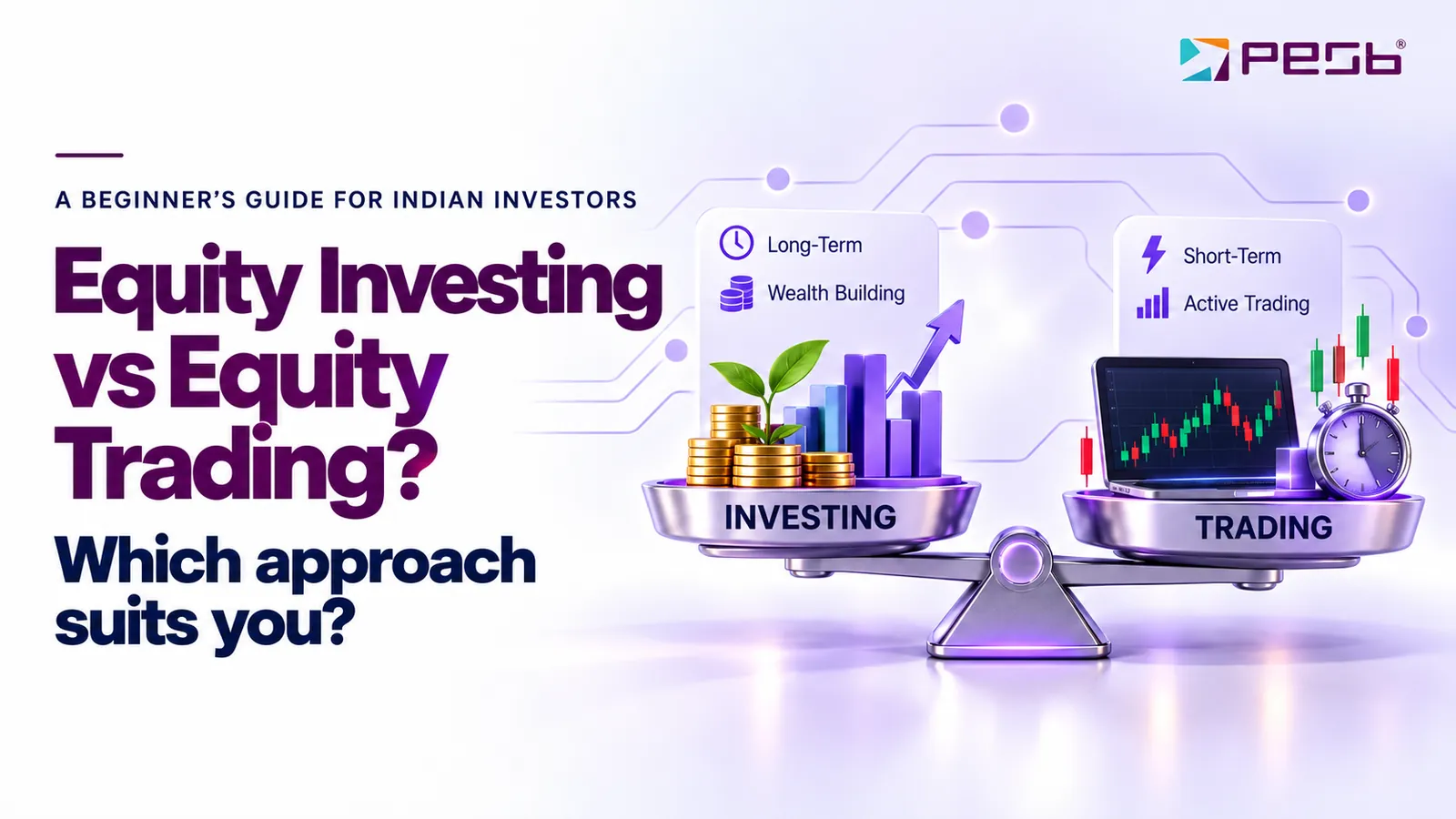
Equity investing vs equity trading at a glance:
- Typical horizon: investing runs for years to decades; trading lasts from seconds to months.
- Analytical basis: investing relies on fundamental analysis; trading on technical analysis and order flow.
- Core objective: investing aims to compound wealth; trading seeks cash flow and alpha capture.
- Exposure vehicles: investors use equities, index funds and ETFs; traders use equities, futures and options.
- Monitoring frequency: investing needs periodic quarterly or annual reviews; trading needs continuous screen time.
2. Fundamental vs. Technical Strategies
How market participants analyze opportunities highlights another core divergence between investing and trading.
Fundamental Analysis for Investors
Long-term equity investors rely on fundamental analysis to determine the intrinsic value of a company. They seek to answer: Is this business fundamentally sound, and is it trading at a fair price relative to its future cash flows?
Key pillars of fundamental analysis include:
- Financial Statement Scrutiny: Assessing the balance sheet (debt-to-equity, cash reserves), income statement (revenue growth, operating margins), and cash flow statement (free cash flow generation).
- Valuation Multiples: Evaluating price-to-earnings (P/E), price-to-book (P/B), enterprise value to EBITDA (EV/EBITDA), and return on equity (ROE).
- Moat & Qualitative Factors: Identifying pricing power, proprietary technology, management governance, brand equity, and barriers to entry.
- Diversification via ETFs: Investors often allocate to an etf as investment to gain instant exposure to broad indices, thematic sectors, or international markets without individual stock picking risk.
Technical and Quantitative Analysis for Traders
Traders prioritize technical indicators, price structure, and volume metrics over annual reports. Their central question is: Where is the price heading next, and what is the risk-to-reward ratio of this setup?
Key tools for active traders include:
- Price Action & Candlestick Patterns: Support and resistance levels, trendlines, breakouts, chart patterns (such as head-and-shoulders, flags, and double bottoms).
- Technical Indicators: Moving averages (EMA/SMA), Relative Strength Index (RSI), MACD, Bollinger Bands, and VWAP (Volume Weighted Average Price).
- Derivatives and Leverage: Utilizing stock options or index futures on a dedicated futures online trading platform to execute directional hedges or leveraged swing trades.
- Market Microstructure: Reading level-2 order books, tape reading, and liquidity sweeps.
3. The Role of ETFs: Building a Resilient Portfolio Base
For many market participants, Exchange-Traded Funds (ETFs) serve as the bridge between passive diversification and active asset allocation.
Integrating an etf in investment strategies allows individuals to capture broad economic expansion. When evaluating an etf investment, you buy a basket of securities that trades on stock exchanges just like an individual equity share.
Why Long-Term Investors Leverage ETFs
- Cost Efficiency: Passive index ETFs generally feature ultra-low expense ratios compared to actively managed funds.
- Elimination of Single-Stock Risk: An investment etf tracking major indices (like the Nifty 50, Sensex, S&P 500, or sector-specific baskets) reduces the risk of bankruptcy or governance failure in any single constituent.
- Simplicity and Compounding: Allocating capital toward systematic investment in etf products enables steady dollar-cost or rupee-cost averaging, building sustained long-term wealth.
How Traders Utilize ETFs
Traders also use ETFs for short-term tactical plays. Rather than picking a single banking or technology stock, a trader might trade sector-specific ETFs to express a macro view, take advantage of interest rate announcements, or capture momentum across commodity-backed assets like gold and silver.
4. Psychological Discipline: Patience vs. Rapid Execution
Market success is rarely just a test of intellectual acumen; it is predominantly an exercise in emotional control. However, investing and trading demand distinct psychological temperaments.
The Investor’s Temperament: Patience and Inaction
- Tolerating Boredom: Successful investing often feels uneventful. It involves buying great assets and letting compounding work over extended cycles without unnecessary interference.
- Resisting Panic: During macroeconomic recessions or bear markets, portfolio values drop. An investor needs the emotional conviction to stay invested or accumulate more when sentiment is bleak.
- Avoiding FOMO: Investors must ignore speculative market bubbles and stick to their asset allocation plan.
The Trader’s Temperament: Decisiveness and Absolute Risk Rules
- Strict Loss Acceptance: In trading, taking losses is an inherent operating cost. A trader must execute stop-loss orders mechanically without emotional attachment or hope-based holding.
- Fast Decision-Making: Opportunities emerge and vanish quickly. Hesitation or second-guessing leads to slippage and missed risk-reward ratios.
- Handling Tilt and Overtrading: After a string of losses, the temptation to engage in "revenge trading" to recover capital can wipe out an account. Elite traders maintain strict daily risk caps.
5. Choosing the Best Trading and Investing Infrastructure
Whether your strategy leans toward long-term investing or high-frequency trading, your execution infrastructure determines transaction efficiency, analytical speed, and overall costs.
Global financial ecosystems highlight platforms like the fidelity online trading platform or the charles schwab online trading platform (often referenced simply as the schwab online trading platform), which are well regarded for wealth management tools, dividend tracking, and educational materials.
When searching for the best online trading platform or evaluating the best online broker trading platform for your specific requirements, assess the following critical features:
Key Considerations for Traders
- Execution Latency: Fast order routing is essential when prices fluctuate within milliseconds.
- Advanced Charting and Screeners: The best platform for online trading should offer multi-timeframe charting, customizable indicator libraries, and real-time alerts.
- Derivatives Capabilities: If you trade indices or commodities, having access to a high-speed futures online trading platform with clear margin management and bracket orders is vital.
- Cost Transparency: Low brokerage fees, competitive margin rates, and transparent statutory charges preserve profit margins for active scalpers and intraday traders seeking the best trading online platform.
Key Considerations for Investors
- Depository Safety and Custody: Regulatory integrity, depository participant certifications, and transparent reporting.
- Comprehensive Asset Access: Seamless order routing for cash equities, sovereign bonds, mutual funds, and thematic ETFs on an online trading best platform.
- Research Quality: Access to SEBI-registered research analysts and institutional-grade company reports to evaluate fundamentals.
For Indian market participants, partnering with a corporate broker that combines cutting-edge analytical tools with professional research is paramount. At Pune E Stock Broking Limited (PESB), our 17+ years of industry experience across NSE, BSE, MCX, and NCDEX, coupled with dedicated SEBI-registered research analyst support (Reg. No: INH000018197), provides the foundation for both active traders and long-term portfolio builders.
6. How to Decide Which Path Fits You
If you are uncertain where to begin, evaluate your current resources, availability, and financial objectives:
- Long-term equity and ETF investing suits you if you have a full-time career outside finance, want hands-off wealth that compounds over decades, and prefer evaluating balance sheets and business models.
- Short-term active trading (intraday, swing or F&O) suits you if you can dedicate screen time during market hours, enjoy technical charts, maths and rapid execution, and have strict emotional discipline for stop-losses.
- The hybrid approach (core and satellite) suits you if you want core long-term holdings in ETFs and equities with a smaller satellite of tactical trades.
The Hybrid "Core and Satellite" Model
Many successful market veterans do not choose strictly between investing and trading; they utilize both through a Core and Satellite framework:
- Core Portfolio (70%–80%): Allocated to blue-chip equities, long-term compounders, and index or sector ETFs held across market cycles.
- Satellite Portfolio (20%–30%): Allocated to active swing trading, options strategies, or momentum breakouts executed through an online trading platform best suited for dynamic technical setups.
This structure ensures long-term compounding remains protected while allowing active market participants to capitalize on short-term alpha.
Summary Checklist: Getting Started the Right Way
- Define Your Objective: Clarify whether you are seeking long-term retirement wealth creation or generating supplementary trading cash flow.
- Select Your Strategy: Commit to mastering fundamental analysis for value investing or price-action technicals for momentum trading.
- Establish Rigorous Risk Rules: Never risk more than 1–2% of trading capital on a single speculative idea, and maintain asset diversification across your investment holdings.
- Choose a Reliable Broker: Partner with a regulated, experienced broker that provides responsive customer care, comprehensive exchange access, and low-latency digital trading.
Ready to embark on your financial journey with a trusted partner? Connect with our team of specialists and contact Pune E Stock Broking Limited today to open your trading and demat account.
Related resources
- futures online trading platform
- schwab online trading platform
- fidelity online trading platform
- etf as investment
- etf in investment
- etf investment
This article is for information and education only and is not investment advice. Investments in securities market are subject to market risks; read all related documents carefully before investing.