



Mutual FundsInvestor EducationBy PESB11 min read
Exit Load in Mutual Funds: How It Works for SIPs and Redemptions
Redeem a mutual fund before its holding period ends and the scheme may deduct a small percentage of your proceeds. That deduction is the exit load, and on a systematic investment plan (SIP) it is calculated instalment by instalment, because each monthly purchase starts its own holding period. This guide explains how the charge works, where to verify it and how to compute it before you place a mutual fund redemption request.
Key takeaways
At a glance
- What it is: a one-time percentage deducted from sale proceeds when units are redeemed inside the holding period stated in the scheme documents.
- Where to verify it: the Scheme Information Document, the key information memorandum, later addenda and the fund house website.
- SIP treatment: each instalment has its own clock, and the oldest units are redeemed first.
- What it is not: the recurring expense ratio or a lock-in, and the difference is explained in the sections below.
What is exit load in mutual funds?
An exit load is a percentage deducted from the redemption value when you sell mutual fund units before the holding period stated in the scheme documents. The asset management company (AMC), meaning the fund house, applies it at the time of sale. It is a one-time cost at exit, separate from the recurring expense ratio.
Three terms recur in this guide. Net asset value (NAV) is the per-unit price at which units are issued and redeemed. The Scheme Information Document (SID) is the offer document that states the load alongside the investment objective and fee structure, and the key information memorandum (KIM) is its shorter companion.
The expense ratio is the annual running charge that is absorbed into the NAV every day, so you never see it as a separate deduction. A mutual fund exit load, by contrast, appears only when you redeem inside the stated window, and it directly reduces the cash that reaches your bank account. Comparing schemes on one cost while ignoring the other therefore gives an incomplete picture.
Why do fund houses charge a mutual fund exit load?
Fund houses levy a load mainly to discourage quick exits that disrupt portfolio management. When many investors leave together, the fund manager may have to sell securities at unfavourable prices, and that cost can fall on the investors who stay. The charge compensates the scheme for that disruption rather than adding to the fund house's revenue.
The regulator's framework supports this reading. According to the SEBI Master Circular for Mutual Funds (2024), an exit load charged to an investor is credited to the scheme, net of goods and services tax, so the remaining unitholders benefit from it.
Loads differ widely by scheme, and some schemes waive or reduce them in defined cases, such as redeeming a stated share of units without any charge. For that reason, the scheme's own document is always the final authority, not a general rule of thumb.

Where do you find the exit load in the scheme documents?
Look in the Scheme Information Document under fees and expenses, where the load structure line states the percentage and the holding period. The KIM, the AMC scheme page, the monthly factsheet and any addendum repeat or update that line, so confirm against the latest version before every redemption.
A step-by-step way to verify the charge:
- Download the documents: open the AMC website, go to the scheme page and save the SID and the KIM.
- Find the line: search for the heading titled load structure or exit load under fees and expenses.
- Check the measurement: note whether the period is stated in days, months or years, and that it is counted from the allotment date of each purchase.
- Look for steps: some schemes charge one percentage for very early exits and a lower one for slightly later exits.
- Look for exemptions: some schemes let you redeem a stated portion of units without any load.
- Read the addenda: compare their dates with your purchase dates. The SEBI Master Circular for Mutual Funds (2024) treats a change in load as applying to investments made after the change, so older purchases are generally assessed under the structure in force when you bought them. Confirm this in the specific addendum.
If your expectation and the document differ, the document governs.
How does exit load for SIP instalments work?
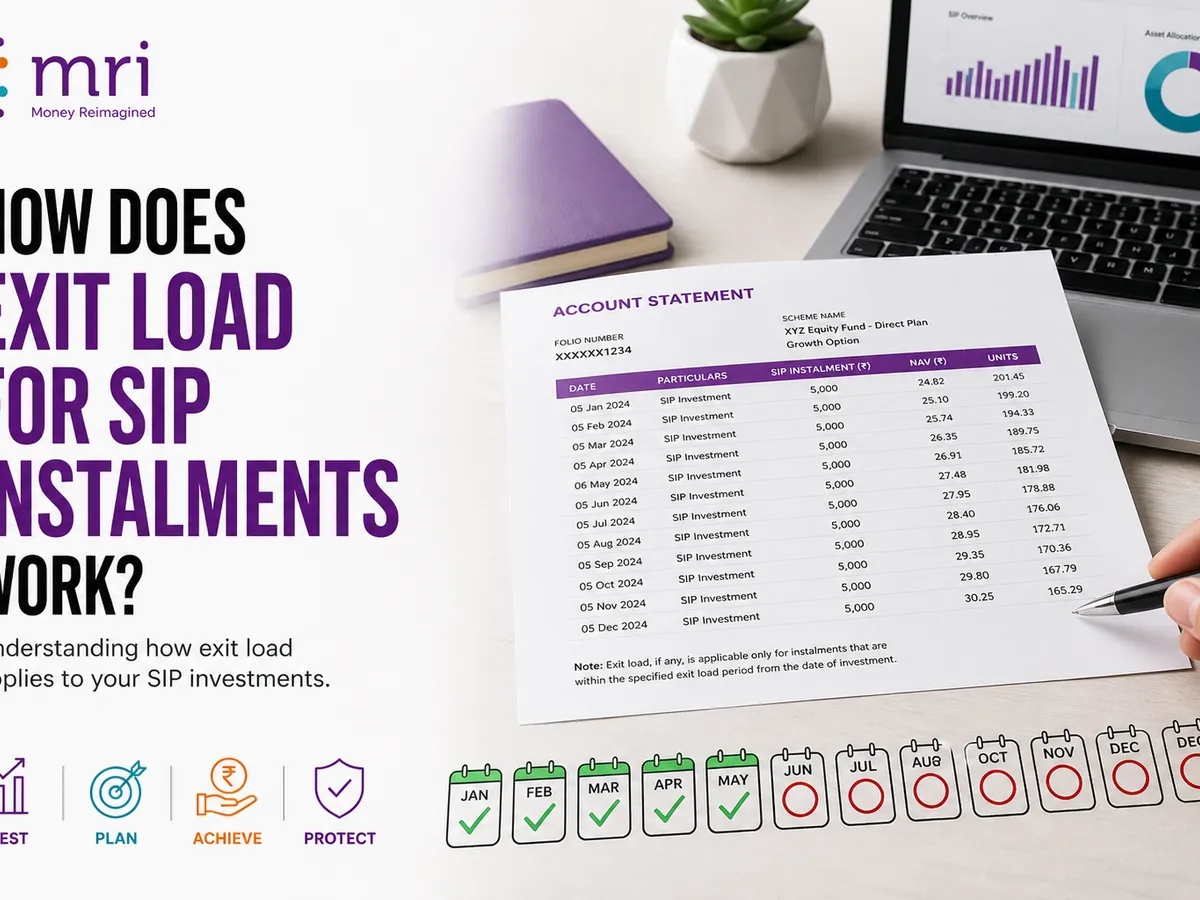
Exit load for SIP investments is assessed on each instalment separately. Every monthly debit buys fresh units on its own allotment date and starts its own holding period. At redemption, the AMC sells units on a first in, first out (FIFO) basis, meaning the oldest instalments leave first.
Once a SIP has run for longer than the load period, its older instalments are usually free of load while its recent instalments still attract the charge. A partial redemption can therefore cost less than a full one, because FIFO draws first on the units that have already cleared the window. A full redemption sweeps in every lot, including those bought recently.
This instalment-wise logic also applies to a lump sum added later and to a systematic transfer plan, since each credit of units carries its own allotment date. Your account statement lists these dates, and it is the quickest way to see which lots are still inside the window. Cross-check the statement against the load line in the SID, not against memory.
A SIP of very recent origin behaves differently: if every instalment is still inside the window, any redemption attracts the load on all the units sold. That is why the timing of the first few instalments matters more than most investors assume.
What are typical exit load structures by fund type?
Structures vary by fund category and by AMC, so treat the following as patterns to look for rather than rules. The scheme document for your specific fund decides the real terms.
- Equity schemes: many AMCs state a flat percentage for exits within a year of allotment, with nothing after that. The period and rate differ by scheme (a pattern in AMC scheme documents, not a regulatory standard).
- Exit load on liquid funds: SEBI prescribed a graded structure for liquid schemes, starting at 0.0070% on redemption on day one and falling step by step to nil from day seven onwards (SEBI circular on liquid funds, 2019). Because the charge is tiny and short, liquid funds suit parking surplus cash.
- Exit load on arbitrage funds: these schemes usually carry a short window, often a matter of weeks, because the strategy relies on stable holdings. Rates and periods are scheme specific, so read the load line before treating one as a cash substitute.
- Debt schemes: the load ranges from nil to short windows depending on category and AMC, and some schemes use graded steps similar to those above.
- Hybrid schemes: these often follow an equity-like pattern with a one-year window, but equity-heavy and debt-heavy hybrids can differ.
- ELSS (equity linked savings schemes): units cannot be redeemed during the lock-in, so a conventional exit load normally does not arise (SEBI Master Circular for Mutual Funds, 2024).
If a fund house revises these terms, the change is published through an addendum, which is why the latest document matters more than any article, this one included.
What is the exit load formula, with an example?
The exit load formula is simple: exit load equals the units subject to the load, multiplied by the NAV on the redemption date, multiplied by the load percentage. Net proceeds equal the gross redemption value minus that load, before tax and other statutory charges. The only real work is working out which units are subject to the load.
The figures below are hypothetical and do not describe any actual scheme. They assume a 1% load on units redeemed within 12 months of allotment, a monthly SIP that has run for 14 months, 20 units bought each month and a redemption NAV of ₹60.
- Step one, apply FIFO: you redeem 100 units. The first two instalments (40 units) are older than 12 months and carry no load. The next three instalments (60 units) are still inside the window (illustrative figures).
- Step two, gross value: 100 units multiplied by ₹60 gives ₹6,000 (illustrative figures).
- Step three, the load: 60 units multiplied by ₹60 gives ₹3,600, and 1% of that is ₹36 (illustrative figures).
- Step four, net proceeds: ₹6,000 minus ₹36 gives ₹5,964, before tax and other statutory charges (illustrative figures).
For comparison, redeeming all 280 units under the same assumptions would put 240 units inside the window. The load would then be 1% of ₹14,400, which is ₹144 (illustrative figures). The partial redemption carried a much smaller charge per unit sold, purely because of FIFO.
How does exit load differ from lock-ins in other products?
An exit load is a price for leaving early, while a lock-in is a ban on leaving. With a load you can always redeem and accept the deduction. With a lock-in, the money is simply unavailable for the stated period, and the two features should not be confused when you plan your liquidity.
Here is how common products compare on the same points:
- Open-ended mutual fund with exit load: units can be redeemed on any business day, and the cost falls away once the window ends.
- ELSS lock-in: units cannot be redeemed for three years from allotment, and each SIP instalment has its own three-year clock (SEBI Master Circular for Mutual Funds, 2024; Income-tax Act, 1961, Section 80C).
- Public Provident Fund: a 15-year tenure, with partial withdrawals permitted only after a few years and subject to limits (Public Provident Fund Scheme, 2019).
- Bank fixed deposit: you can usually break it early, but the bank applies a premature withdrawal penalty set in its own deposit terms.
The practical lesson is to read the exit terms of any product before committing money you might need soon.
What does this mean for you?
For an investor running a SIP, the oldest units carry the lowest exit load, because they are the first to clear the holding period. That is one input among several, though. Tax on gains and your own goals also matter, so exit load should never be the only reason to redeem or to wait.
- SIP investors: check your statement for the allotment date of each instalment and compare the dates with the load period before you redeem. You may wish to discuss with your advisor whether a partial redemption, where FIFO covers units that are already load-free, fits your tax position and your plans.
- First-time redeemers: read the load line in the latest SID and any addendum before you submit the request, and keep a note of the NAV date that will apply to your order.
- People parking surplus cash: compare the exit load on liquid funds and on arbitrage funds with your expected holding time. A fund with a window longer than your need is a poor fit however attractive its category sounds.
- Everyone: treat exit load, expense ratio and tax as three separate costs, and total them for each option instead of judging by one.
How can you place a mutual fund redemption with PESB?
Pune e Stock Broking Limited (PESB) lists a mutual fund desk that handles SIPs and redemptions, along with bonds, gold and ETFs. Before you raise a request, keep the scheme name, your folio details and the number of units or amount you want to redeem at hand, and have the latest load line from the scheme document ready.
You can write to mutualfund@pesb.co.in or find the desk's phone details on the PESB contact page. The desk can help with the process, but the exit load for any scheme is set by its fund house and stated in its documents.
Mutual fund investments are subject to market risks. Read all scheme related documents carefully. Past performance does not guarantee future results, and nothing in this article is a promise of returns or personal investment advice.
Frequently asked questions
Does every SIP instalment have its own exit load period?
Each instalment is assessed on its own allotment date if the scheme charges a load, and only while it is inside the holding period. Instalments past the window pay nothing, and some schemes carry no load at all.
Is exit load the same as the expense ratio?
No. The expense ratio is a recurring annual charge absorbed into the NAV, while the exit load is a one-time deduction on redemption inside the stated window.
How can I avoid paying exit load?
You can redeem after the holding period ends, use any exempt portion the scheme allows, or choose a scheme whose load fits your time horizon. Check the SID and recent addenda first, since terms can change.
Is exit load charged on a mutual fund redemption in a liquid fund?
Liquid funds follow a graded structure prescribed by SEBI in 2019, which falls to nil from the seventh day onwards. Confirm the current terms in your scheme's documents before redeeming.
Related resource
- exit load
- mutual fund exit load
- mutual fund redemption
- exit load for SIP
- exit load formula
- exit load on liquid funds
- exit load on arbitrage funds
This article is for information and education only and is not investment advice. Investments in securities market are subject to market risks; read all related documents carefully before investing.