



Mutual FundsInvestor EducationBy PESB10 min read
Step-Up SIP Explained: Flat vs Stepped-Up SIP Over 10 Years

A flat monthly SIP stays the same size while your income, expenses and financial goals keep growing. A step-up SIP closes that gap by raising the instalment on a schedule you set once, so contributions can track earnings without a fresh decision every year. This guide explains the mechanics, the arithmetic and an illustrative 10-year comparison so you can judge the idea before you commit.
Key takeaways
- A yearly step, whether a percentage or a fixed rupee amount, raises each instalment automatically so that contributions keep pace with income.
- A top-up SIP is usually the same feature under a different label, while a lumpsum top-up is a separate one-time purchase.
- In the illustration below, the stepped-up plan ends with a larger corpus mainly because more money goes in, not because the assumed return is higher.
- Set the step, the cap and the bank mandate limit together, and review them at least once a year.
- All figures here are illustrative arithmetic, not a forecast or a promise of returns.
At a glance
- What it is: a SIP whose monthly instalment rises at a set interval
- Step types: a percentage of the current instalment, or a fixed rupee amount
- Usual interval: once a year, although options differ by fund house
- Illustrative case: ₹10,000 a month for 10 years with an assumed 12% a year (see the illustration box)
- Set-up help: PESB mutual fund desk, with contact details at the end of this guide
- Risk: mutual fund investments are subject to market risks, and no return is assured
How does a step-up SIP work?
In a stepped-up SIP, the monthly instalment rises automatically at a fixed interval, usually once a year. The increase is either a percentage of the current instalment or a fixed rupee amount. Units are still bought every month at that day's net asset value (NAV), the price of one unit of the fund, so only the rupees invested change.
Take a ₹5,000 SIP with a 10% yearly step. Year one runs at ₹5,000, year two at ₹5,500 and year three at ₹6,050, because each increase applies to the latest instalment. With a fixed step of ₹500 instead, the instalments read ₹5,000, ₹5,500 and ₹6,000.
The percentage route compounds the instalment itself, so the rupee increases grow larger in later years. The fixed route rises in a straight line and is easier to budget.
Neither route changes how units are bought. Rupee cost averaging, meaning you buy more units when the NAV is low and fewer when it is high, continues to apply, and the step only changes how many rupees go in each month.
Many plans apply the increase on the SIP anniversary or in a month you choose, and some allow a cap on the instalment. Features differ by fund house, so check the SIP form you plan to use for the interval, step size and cap.
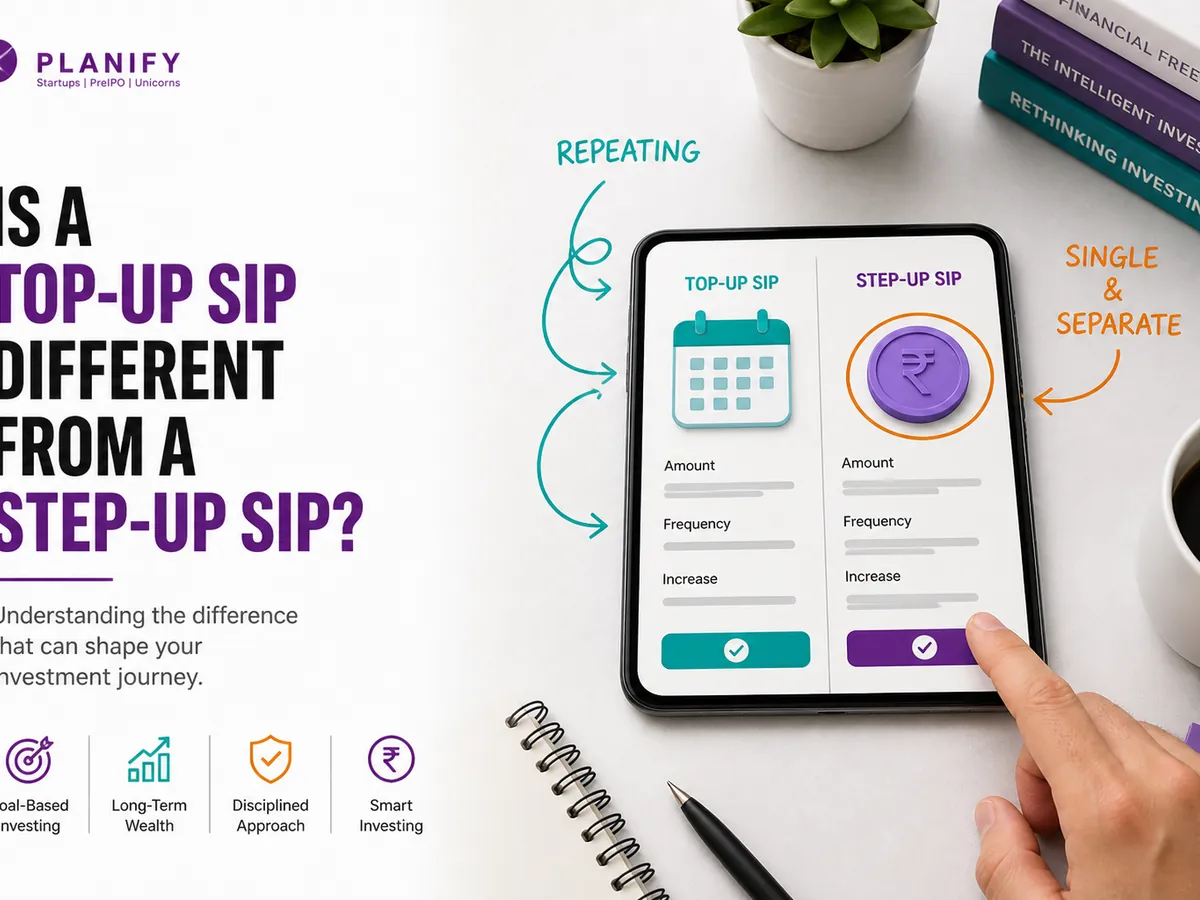
Is a top-up SIP different from a step-up SIP?
On most Indian fund house and platform screens, the two labels describe the same feature: a scheduled increase in the SIP amount. The naming differs, not the mechanics. A top-up SIP should not be confused with a lumpsum top-up, which is a one-time extra purchase in the same folio.
The distinction matters when you read a form. A scheduled increase is set once and runs by itself, whereas a lumpsum top-up needs your action each time. People sometimes search for a 'lumpsum SIP', but the two routes differ: a SIP spreads purchases across many months, while a lumpsum is a single purchase made on one day.
Investors with irregular income can treat the two features as separate tools. A modest scheduled step keeps the instalment affordable in leaner months. Lumpsum top-ups then remain optional extras from surplus cash, not a commitment.
What is the step-up SIP formula and how do you calculate it?
To work out the corpus, go year by year. Each year contains twelve equal instalments, and the next year's instalment equals the previous one multiplied by one plus the step rate. Grow each year's instalments to the end date at the assumed monthly rate, then add the results.
The year-by-year method in four steps:
- Fix the first-year instalment, the yearly step and the assumed annual return, then divide the annual return by 12 to get the monthly rate.
- Work out each year's instalment: multiply by (1 + step rate) for a percentage step, or add the fixed amount.
- Value each year's twelve instalments at the end of that year using the monthly rate.
- Carry each year's value forward to the final month at the monthly rate, then add all the years together.
A good sip investment plans calculator runs these same steps behind the screen. Many also offer a yearly table or chart and an inflation option. Check whether the tool assumes month-start or month-end instalments, because that choice shifts the result slightly.
For spreadsheet users
For a percentage step, let P be the first-year instalment, r the monthly rate, s the yearly step rate and n the number of years. With month-end instalments, the closing corpus is:
FV = P × [((1+r)^12 - 1) / r] × [((1+r)^(12n) - (1+s)^n) / ((1+r)^12 - (1+s))]
In a spreadsheet, put P in B1, the annual rate in B2, s in B3 and n in B4, then enter:
=B1*(((1+B2/12)^12-1)/(B2/12))*(((1+B2/12)^(12*B4)-(1+B3)^B4)/((1+B2/12)^12-(1+B3)))
Changing the years in B4 updates both the month count and the exponent, so you can test a 5-year or 15-year horizon. A fixed rupee step needs the year-by-year schedule instead.
How does a flat SIP compare with a stepped-up SIP over 10 years?
Under the assumptions below, a flat ₹10,000 SIP builds about ₹23.0 lakh, while a 10% yearly step builds about ₹33.4 lakh. The gap comes mostly from the extra rupees invested, because the assumed return is identical in every case. A step up SIP for 10 years changes your contribution path, not the market.
Illustration assumptions (illustrative only, not a forecast)
- Starting instalment of ₹10,000 a month, paid at month end
- Duration of 10 years, or 120 instalments
- An assumed return of 12% a year, applied as 1% a month, chosen only to keep the arithmetic simple
- Step options of 10% a year or ₹1,000 a year, applied once at the start of each year
- Costs, taxes and exit loads ignored
At a glance: the three plans compared
- Flat SIP: ₹12.0 lakh invested; corpus about ₹23.0 lakh; gain about ₹11.0 lakh; about 1.92 times the amount invested
- 10% yearly step: about ₹19.1 lakh invested; corpus about ₹33.4 lakh; gain about ₹14.3 lakh; about 1.75 times; final-year instalment about ₹23,579
- Fixed ₹1,000 yearly step: ₹17.4 lakh invested; corpus about ₹31.1 lakh; gain about ₹13.7 lakh; about 1.79 times; final-year instalment ₹19,000
The multiple on money invested is lower for the stepped plans because later instalments have less time to compound. A bigger final corpus therefore does not mean better efficiency per rupee. The real question is whether you can afford the larger monthly outlay.
Real markets do not deliver a constant return. Equity fund NAVs rise and fall, and a stepped-up plan can show a loss in any given year.
Mutual fund investments are subject to market risks, read all scheme related documents carefully. (SEBI standard mutual fund disclaimer)
Share on LinkedIn · Share on X

Should you choose a percentage step or a fixed step?
A percentage step suits salaried investors whose pay rises by a roughly steady proportion, since the instalment grows with income. A fixed step suits those who prefer predictable increments and a smoother budget. Both rely on the same unit-buying mechanics, so the choice depends mainly on how your cash flow behaves.
- Pick a percentage step if your income grows each year and you want the SIP to scale with it.
- Pick a fixed step if you want to know the exact instalment in every future year.
- Match the step to your own costs: if you want the SIP to keep pace with rising living costs, set the step near your own expected increase in expenses, a figure only you can estimate.
How do you set up a step-up SIP?
Choose the fund, select the step-up or top-up option on the SIP form, and enter the step type, the size of the step and the interval. Check the bank mandate limit before you submit. The PESB mutual fund desk can help with the paperwork.
- Complete your KYC (know your customer) formalities and choose a scheme that fits the goal and the time horizon.
- Enter the first instalment and a SIP date you can sustain through the year.
- Pick the step type (percentage or fixed), the step size and the interval.
- Set a cap if the form offers one, so that the instalment cannot outgrow your budget.
- Confirm that the bank mandate limit covers the highest future instalment, because a debit above the limit can be rejected.
- Submit the form and keep the acknowledgement for your records.
When should you revisit the step?
Review the step once a year, ideally near your SIP anniversary or appraisal month, and again after a major life event. Revisit it when income changes, a new goal appears, an instalment begins to strain your budget, or the cap is reached.
- Income change: a raise, a job change or a slower business year can justify a bigger or smaller step.
- New goal: a child's education or a home purchase may need a separate SIP rather than a bigger step.
- Budget strain: lowering or pausing the step is a legitimate choice if cash flow tightens.
- Market moves: avoid changing the step only because of short-term NAV swings.
What this means for you
The points below apply to anyone who invests through SIPs.
- Salaried investors: align the step with your appraisal cycle so that the increase feels painless.
- Traders and business owners with variable income: choose a modest step, and treat lumpsum top-ups as optional extras from surplus cash.
- New or first-time SIP investors: start with an instalment you can sustain, pick a small step, and review your first-year statement before you raise it.
- Goal-based investors: run the numbers for your own horizon, whether 5, 10 or 15 years, in a calculator before you choose a step.
Frequently asked questions
Is a stepped-up SIP better than a regular SIP?
Not automatically. A stepped-up plan invests more over time, so its corpus is larger, but it needs a rising monthly outflow. Whether it suits you depends on your income growth and on how the fund performs, which no illustration can promise.
How do I calculate a stepped-up SIP in Excel?
Build a year-by-year schedule, or use the closed-form formula with cell references for the instalment, rate, step and years. Change the years cell to test other horizons. Use the schedule when the step is a fixed rupee amount.
Can I stop or change a step later?
Most fund houses let you pause, stop or modify a SIP, but the rules and notice periods differ. Check the form and the scheme documents before you rely on a change. The PESB mutual fund desk can help you check.
How is a lumpsum top-up different from a scheduled step?
A scheduled step raises the SIP automatically every year. A lumpsum top-up is a one-time extra purchase that you place yourself, whenever you choose. Many investors use a small step for discipline and add lumpsums only from surplus.
Talk to PESB's mutual fund desk
To set up a SIP with a yearly step, contact PESB's mutual fund desk at mutualfund@pesb.co.in or 020 41000 609/610 (Source: PESB contact page). The contact page lists this desk for SIP, redemptions, bonds, gold and ETFs. What yearly step could you sustain for the next five years? Settle that first, then choose the instalment.
This guide is educational and is not personal investment advice. Illustrations do not assure returns, and mutual fund investments are subject to market risks.
Related resource
- step-up SIP
- top-up SIP
- sip investment plans calculator
- step up SIP for 10 years
- step-up SIP formula
- lumpsum SIP
This article is for information and education only and is not investment advice. Investments in securities market are subject to market risks; read all related documents carefully before investing.