


Market cycles are inherently unpredictable. Economic expansions give way to tightening monetary policy, sudden geopolitical shocks disrupt supply chains, and sector rotations can rapidly erase paper gains in concentrated portfolios. For individual investors and wealth managers alike, the antidote to market fragility is not attempting to forecast short-term macro swings, but constructing a resilient, multi-asset portfolio designed to weather all economic climates.
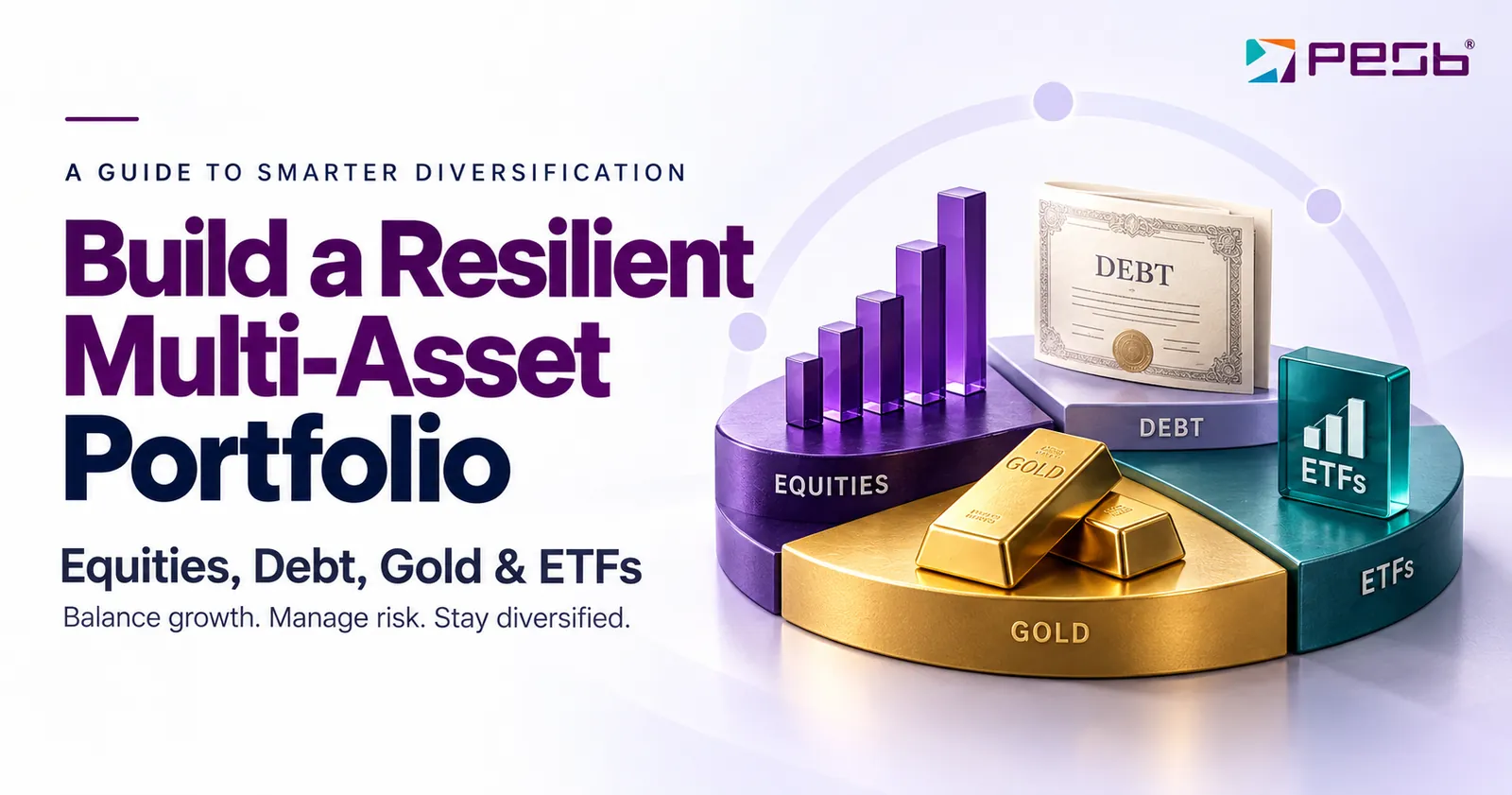
A truly diversified portfolio does not merely mean owning twenty different stocks within the same index. Genuine diversification spans distinct asset classes—equities, fixed-income instruments, precious metals, agricultural and industrial commodities, mutual funds, and exchange-traded funds (ETFs). When combined systematically through modern portfolio theory, these distinct assets balance capital appreciation with downside protection.
1. The Core Pillars of Multi-Asset Diversification
Every asset class plays a distinct functional role within a balanced wealth creation strategy. Understanding how these pillars interact enables investors to build portfolios that capture upside growth without suffering catastrophic drawdowns during market corrections.
Equities (Direct Stocks & Equity Funds)
Equities represent ownership stakes in businesses and remain the premier engine for beating inflation and driving long-term capital compounding. While equities exhibit higher volatility in the short run, historical data across Indian and global markets demonstrates that broad-market equities reward patient capital over five-to-ten-year horizons. Within an equity bucket, diversification should extend across large-cap stability, mid-cap growth, and selective small-cap exposure.
Debt and Fixed Income (Bonds, G-Secs, Liquid Instruments)
Fixed-income securities provide liquidity, regular cash flow via coupon payments, and capital preservation. Government securities (G-Secs), corporate bonds, state development loans, and debt mutual funds act as shock absorbers when equity valuations compress. During market downturns, high-quality sovereign debt often appreciates as central banks ease interest rates to stimulate economic activity.
Gold and Commodities
Precious metals like gold have served as stores of value and monetary hedges for centuries. Gold typically exhibits a low or negative correlation with equities during inflationary spikes and currency depreciations. Industrial commodities (like crude oil and base metals) and agricultural commodities offer tactical hedging opportunities against real-economy supply bottlenecks.
Exchange-Traded Funds and Mutual Funds
Mutual funds and ETFs provide instantaneous diversification across hundreds of underlying securities at low transaction costs. An etf as investment instrument allows market participants to gain targeted exposure to broad market indices (such as Nifty 50 or Sensex), international benchmarks, thematic sectors, or physical gold—all tradable in real time during market hours.
2. Understanding Asset Correlation and Risk Tolerance
The fundamental mathematics behind modern portfolio construction relies on asset correlation—the statistical measure (-1.0 to +1.0) of how two assets move in relation to one another.
- Positive Correlation (+0.7 to +1.0): Assets move in the same direction. For instance, high-beta cyclical stocks and mid-cap growth stocks often rise and fall together.
- Uncorrelated Assets (0.0 to +0.3): The price movement of one asset has little to no statistical relationship with the other. High-grade government bonds frequently demonstrate little correlation with broad equity moves.
- Negative Correlation (-0.3 to -1.0): Assets move in opposite directions. Gold and the US Dollar often move inversely, while sovereign debt yields and bond prices have an exact inverse relationship.
On the correlation spectrum, -1.0 is a perfect negative hedge, 0.0 is an uncorrelated diversifier and +1.0 means high risk concentration.
When you combine assets with low or negative correlation, you reduce the portfolio's overall standard deviation (volatility) without proportionally sacrificing expected return. This efficiency expands what Nobel laureate Harry Markowitz termed the "Efficient Frontier."
Risk Tolerance Assessment Framework
Before allocating capital across asset classes, every investor must evaluate three dimensions of risk:
- Risk Capacity: The objective financial ability to withstand losses, determined by income stability, net worth, existing liabilities, and emergency cash reserves.
- Risk Willingness: The psychological and emotional disposition toward market drawdowns. Can you watch your portfolio drop 15% without panic selling at the bottom?
- Time Horizon: The duration until the invested capital is required for specific life milestones (e.g., retirement, buying a home, education funding). Longer horizons permit higher equity and commodity allocations.
3. The Power of ETFs and Mutual Funds in Modern Asset Allocation
For most individual investors, building a multi-asset portfolio solely through single-stock picking and direct bond purchases introduces high operational complexity and single-company risk. Incorporating an etf in investment strategies simplifies asset allocation while maximizing cost efficiency.
Why ETF Investment Is Transforming Portfolio Management
A strategic etf investment structure combines the real-time liquidity and trading flexibility of equities with the risk diversification of traditional index funds. When evaluating an investment etf for your portfolio, consider several distinct structural advantages:
- Intraday Liquidity: Unlike mutual funds, which compute Net Asset Value (NAV) at the close of trading, an investment in etf units allows investors to execute buy and sell orders at transparent, live market prices throughout trading hours.
- Ultra-Low Expense Ratios: Passive index ETFs eliminate costly active fund management fees, meaning a greater percentage of compounded returns remains in the investor's portfolio over multi-decade holding periods.
- Targeted Asset Exposure: Specialized ETFs provide immediate entry into gold, silver, public sector undertaking (PSU) bonds, corporate debt baskets, and global indices with a single trade execution.
Integrating mutual fund Systematic Investment Plans (SIPs) for rupee-cost averaging alongside tactical ETF investments on market pullbacks establishes a balanced core-and-satellite portfolio framework.
4. Structuring Strategic Asset Allocation Models
Depending on your risk assessment profile, asset allocation weights should be tailored to match your specific return expectations and volatility comfort levels.
Strategic Asset Allocation Profiles at a Glance
- Conservative Capital Preservation: 20% Equities (Index ETFs & Large-Cap Funds), 65% Fixed Income (Government Bonds, Corporate Debt Funds, Liquid Instruments), 10% Sovereign Gold Bonds/Gold ETFs, 5% Cash Equivalents.
- Balanced Multi-Asset Growth: 50% Equities (Diversified Large & Mid-Cap Equities, Sectoral ETFs), 30% Fixed Income (Target Maturity Debt Funds, High-Yield G-Secs), 15% Gold & Commodity ETFs, 5% Liquid Funds.
- Aggressive Wealth Accumulation: 70% Equities (Direct Stocks, Small & Mid-Cap Funds, Emerging Market ETFs), 15% Debt Instruments, 10% Gold & Commodities, 5% Tactical Derivatives.
- Ray Dalio-Inspired All-Weather Allocation: 30% Equities, 40% Long-Term Government Bonds, 15% Intermediate Bonds, 7.5% Gold, 7.5% Broad Commodities.
By matching your capital with a dedicated model, you avoid emotional decision-making during euphoric bull markets and terrifying market panics.
5. Tactical Hedging: The Role of a Futures Online Trading Platform
While long-term core allocations should remain steady, advanced investors and institutional traders frequently utilize derivative contracts to protect equity capital against sharp downside events. Access to a sophisticated futures online trading platform allows investors to deploy defensive overlay strategies without liquidating their underlying physical stock holdings.
Key Futures Hedging Strategies
- Portfolio Index Hedging: If you hold a diversified basket of blue-chip Indian equities and anticipate short-term macroeconomic turbulence, you can sell Nifty 50 or Sensex futures contracts. Gains on short futures positions can offset paper losses in your core stock holdings.
- Commodity Price Risk Management: Active participants in physical commodities or commodity-sensitive stocks can hedge against price fluctuations on commodity exchanges such as MCX and NCDEX.
- Tactical Capital Allocation: Futures contracts require only a fraction of the total trade value as initial margin, enabling experienced market participants to gain temporary tactical market exposure while keeping core capital parked in liquid, yield-bearing debt instruments.
Derivative trading involves leverage and necessitates rigorous risk management, disciplined stop-loss execution, and deep understanding of contract rollover dynamics.
6. What Defines the Best Online Trading Platform?
Global investors evaluating platforms often benchmark against international giants such as the fidelity online trading platform or the charles schwab online trading platform (frequently referenced simply as the schwab online trading platform). These international benchmark brokers are renowned for comprehensive multi-asset research, seamless order execution, advanced charting, and integrated cash management.
When Indian market participants search for the best online trading platform or look to identify the best online broker trading platform, similar foundational capabilities must be met. The best platform for online trading must eliminate friction between distinct financial exchanges and product types.
Key Evaluation Criteria for an Online Trading Platform
- Multi-Exchange Execution Speed: The best trading online platform provides unified access across equity exchanges (NSE, BSE) and commodity markets (MCX, NCDEX) with ultra-low latency order routing.
- Seamless Asset Integration: An online trading best platform enables users to hold equities, government bonds, mutual funds, and ETFs in a single consolidated depository account (CDSL/NSDL).
- Institutional-Grade Research: An online trading platform best suited for long-term wealth creation must provide SEBI-registered research analyst insights, detailed fundamental valuation metrics, and technical charting overlays.
- Robust Security and Regulatory Pedigree: High financial integrity, zero conflicts of interest, and a clean regulatory track record across decades of operational history.
7. The Discipline of Periodic Rebalancing
Constructing an asset allocation model is only the first step. Over time, differing rates of return will cause your portfolio weights to drift. If equities experience a parabolic bull run, your equity allocation might expand from 50% to 75% of your total wealth. Without realizing it, you are now exposed to far more downside risk than your initial risk assessment intended.
Periodic rebalancing is the mathematical mechanism that restores your target asset allocation.
Rebalancing Methodologies
- Calendar-Based Rebalancing: Reviewing and adjusting portfolio weights on a fixed schedule (e.g., semi-annually or annually). This approach minimizes transaction costs and capital gains tax events while maintaining strategic discipline.
- Threshold-Based (Band) Rebalancing: Rebalancing occurs only when an asset class drifts beyond a pre-determined tolerance band (e.g., +/- 5% from target weight). If your target gold allocation is 15% and it surges to 21%, you trim the excess 6% and reallocate it to undervalued fixed income or equities.
- Cash-Flow Rebalancing: Directing new capital inflows (monthly SIPs, bonus payouts, dividend distributions) exclusively toward underweighted asset classes until baseline targets are restored, thereby avoiding taxable disposals of appreciated assets.
Rebalancing systematically enforces the timeless investing adage: "Sell high, buy low." It requires selling portions of your best-performing assets after a major rally and buying assets that have lagged but remain fundamentally sound.
8. Multi-Exchange Ecosystem: How PESB Supports Diversified Wealth Building
Implementing a multi-asset strategy in the Indian financial ecosystem requires a corporate broking partner that bridges the gap between disparate market segments. Founded in 2007, Pune e Stock Broking Limited (PESB) delivers the institutional technology, market access, and analytical research required to build and maintain resilient portfolios.
The PESB multi-asset ecosystem at a glance:
- Equities and ETFs: NSE and BSE
- Fixed income: bonds and G-Secs
- Commodities: MCX and NCDEX
- Mutual funds: direct SIPs
- Across every segment: high-speed order routing and SEBI-registered research analysis
Why Investors Choose PESB for Diversified Wealth Creation
- Comprehensive Multi-Exchange Memberships: Full trading access across stock exchanges (NSE & BSE) and premier commodity exchanges (MCX & NCDEX), enabling integrated equity, debt, and commodity execution under one roof.
- Certified SEBI Research Analyst Guidance: Backed by SEBI Research Analyst Registration (INH000018197), PESB provides clients with objective, data-driven equity recommendations and commodity market trends.
- Depository Participant Services: As an authorized CDSL Depository Participant (DP ID: IN-DP-479-2020), PESB ensures safe custody, fast share settlements, and transparent holding statements.
- 17+ Years of Industry Excellence: Serving over 75,000 clients across 15+ cities with dedicated dealer support, personalized customer care, and cutting-edge internet-based trading infrastructure.
Whether you are executing a systematic etf investment plan, hedging price fluctuations on a dedicated futures online trading platform, or building a custom fixed-income basket, PESB provides the technological stability and expert guidance needed to achieve your financial milestones.
9. Conclusion: Start Building Your All-Weather Portfolio Today
Financial security is not created by chasing short-term market speculation or betting everything on a single high-flying stock. True long-term wealth is built through the disciplined construction of a multi-asset portfolio, grounded in asset correlation theory, tailored to individual risk tolerance, and maintained through unemotional periodic rebalancing.
By leveraging modern investment instruments—from low-cost ETFs and mutual funds to direct equities, sovereign debt, and commodities—you position your balance sheet to compound wealth steadily in bull markets while insulating your capital from inevitable economic headwinds.
Ready to transform your investment approach with institutional-grade research and multi-exchange execution? Get in touch with the team at PESB to open your integrated trading and demat account today.
Related resources
- etf investment
- etf in investment
- investment etf
- investment in etf
- futures online trading platform
- best online trading platform
This article is for information and education only and is not investment advice. Investments in securities market are subject to market risks; read all related documents carefully before investing.