


Trading EducationMarket RegulationBy Sheilandra Singh9 min read
Algorithmic Trading India: How Rules-Based Automated Trading Works
Algorithmic trading in India has moved beyond institutional dealing desks, and SEBI's 2025 framework expressly covers retail participation (SEBI, 2025). Many retail users still see terms such as algo, API and order routing without knowing who controls an order or where the risk sits. This guide explains the full chain in plain English, with education only and no performance claims.
Key Takeaways
- An algorithm, or algo, is a set of predefined instructions for entering, exiting and sizing trades.
- A rules based trading system improves consistency, but it cannot remove market risk.
- Orders travel from the strategy through broker risk checks to the exchange matching engine.
- SEBI issued broad algo guidelines in 2012 and a dedicated retail framework in February 2025 (SEBI, 2012; SEBI, 2025).
- Automation adds speed and discipline, never certainty. Every automated order can lose money.
At a glance
- Core idea: Software executes written trading rules without manual clicks.
- Main controls: Entry conditions, exit conditions, position limits and stop losses.
- Execution path: Market data, strategy check, broker risk check, exchange routing and confirmation.
- Regulation: SEBI's 2012 broad guidelines and February 2025 retail participation framework apply.
- Reality check: A good backtest is not a promise of future returns.
What Is Algorithmic Trading in India?
Algorithmic trading in India means using software to place buy and sell orders on Indian exchanges according to predefined conditions. The algo watches market data, checks the entry, exit and risk rules, and sends valid orders through the broker. The trader defines the logic in advance instead of clicking each order manually.
An algorithm is a fixed recipe. A basic example is a rule that buys when a short-term moving average rises above a long-term moving average. The same system exits when the short-term average falls back below. The software checks the condition on each update and acts without hesitation or emotion. This improves consistency, but it does not create certainty.
Retail investors generally use one of two routes:
- Broker-provided tools: Rule builders let users set conditions without writing code.
- API-based strategies: Custom software connects to the broker through an application programming interface, or API.
A platform for algo trading in India should explain who approves strategies, how orders are checked, and how trading can be paused. The label of the tool matters less than the controls behind it.
Rule-based automation is not limited to one equity order. Where the broker and product support it, similar logic can be used for commodity trading in India. Basket trading places a group of orders as one coordinated instruction across several securities. These uses follow the same pattern: conditions in, orders out.
What Is a Rules Based Trading System?
A rules based trading system is a strategy written as exact conditions for entering a trade, exiting it and limiting its size. Because every decision is defined in advance, software can test the logic on historical data and apply it consistently. The system controls the process, not the market result.
Most systems use three rule families:
- Entry rules: The precise trigger for a buy or short sale, such as an indicator crossover.
- Exit rules: The profit target and stop loss, which is the predefined price for closing a losing trade.
- Risk rules: Position sizing, capital limits and the maximum loss allowed in a day or trade.
A careful build process has four steps:
- Write the entry, exit and risk rules in plain language.
- Backtest the rules by running them against historical market data.
- Paper trade the strategy, meaning test it live without real money.
- Deploy small capital and review every order and exception.
A strategy can be overfitted, meaning tuned so closely to past data that it captures noise rather than a repeatable pattern. A strong historical result is evidence, not proof.
Automated Trading Explained: How Does an Algo Execute?
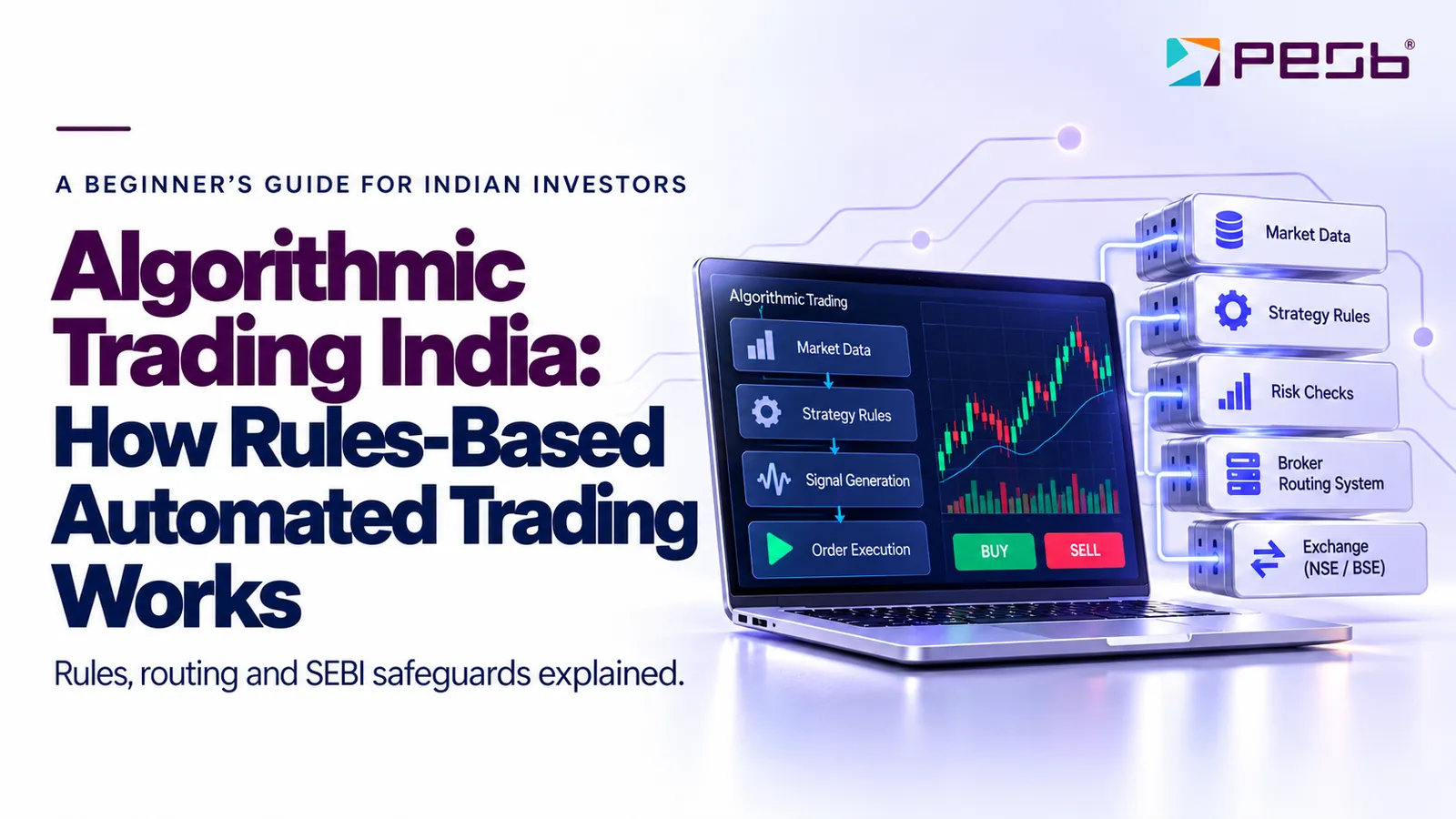
Here is automated trading explained in practical terms. Market prices stream into the software, and the strategy checks its rules. A valid signal creates an order, the broker runs pre-trade checks, and the order goes to the exchange. The exchange then matches it with a compatible counter-order and returns confirmation.
The usual order lifecycle has five steps:
- Market data arrives: The exchange broadcasts prices and order-book updates.
- Signal check: The algo compares the data with its rules.
- Pre-trade checks: The broker verifies margin, price bands and position limits.
- Order routing: The broker sends the valid order to the exchange.
- Matching and confirmation: The matching engine executes the order and reports the result.
SEBI's 2012 guidelines placed automated order flow inside broker risk controls before it reached the exchange (SEBI, 2012). Machine speed does not mean zero delay. Internet quality, server load, exchange traffic and broker checks can affect latency, which is the delay between signal and execution. Slippage is the difference between the expected price and the actual execution price.
How Does Order-Routing Technology Work?
Order-routing technology is the broker infrastructure that receives an order, checks it and sends it to the correct exchange. It usually includes an order management system for order handling and a risk management system for limits. The exchange matching engine, not the broker, completes the trade.
An order management system, or OMS, records and routes orders. A risk management system, or RMS, applies controls such as margin availability, quantity limits and price checks. These systems also create an audit trail showing when an order was created, changed, rejected or executed.
Retail investors should ask practical questions before connecting any strategy:
- Who owns and operates the strategy?
- Where does the software run?
- What pre-trade checks apply?
- Can the user pause the strategy immediately?
- How can order logs and rejection messages be reviewed?
A broker's public pages can help investors understand how a firm describes its research and technology approach. One page to review is PESB's Technology-Led Broking Approach, alongside its regulatory disclosures. Public information is a starting point, not a substitute for direct questions.
What Risks Should Retail Investors Understand?
Automation changes how decisions are executed, but it does not remove market risk. The main dangers are flawed logic, poor testing, leverage, technical failure, volatility, vendor dependence and overconfidence after a good backtest. Every automated order can lose money, and speed can multiply mistakes.
Important risks include:
- Market risk: Prices can gap through a stop loss during sudden news or low liquidity.
- Model risk: A rule may be based on a pattern that no longer works.
- Execution risk: Delay, slippage, rejection or partial fills can change the result.
- Technology risk: Internet, API, server or data failures can interrupt monitoring.
- Leverage risk: Leverage means controlling a larger position with less capital, which can magnify losses.
- Vendor risk: A third-party strategy may hide its logic or fail without warning.
- Behavioural risk: Users may override risk limits after losses or increase size after gains.
Be cautious of algorithmic trading offerings in India that promise assured profits, fixed returns or risk-free automation. No software can remove market risk. Verify the role and registration status of anyone providing investment advice or research. SEBI registration, where required, supports accountability but does not validate future performance.
What SEBI Oversight Applies to Retail Algo Trading?
SEBI issued broad algo-trading guidelines in 2012 and added a dedicated retail framework in February 2025. The current approach allows retail access through supervised brokers, with broker approval, audit trails and exchange registration for algos above specified order-rate thresholds. Retail users remain responsible for understanding the strategy and its risks.
The 2012 broad guidelines on algorithmic trading focused on broker-level controls, system safeguards and auditability. They established that speed does not remove the broker's responsibility to check order flow (SEBI, 2012).
The February 2025 circular then addressed retail participation directly.
"Safer participation of retail investors in Algorithmic trading" (SEBI, 2025)
Share on LinkedIn · Share on X
The title signals the policy balance. Retail access is permitted, but it sits inside a supervised perimeter. The framework puts the broker at the centre because the broker controls exchange access and must identify, monitor and stop algo flow when needed (SEBI, 2025).
The 2025 framework covers API-based retail access, broker approval and unique identification of algo orders. It also requires registration through the broker when an algo crosses an exchange-specified order-rate threshold. For third-party tools, it uses an exchange-empanelled structure while the broker retains supervisory responsibility (SEBI, 2025). Together, these SEBI algo trading rules make the broker the accountable control point.
Before using an algo, ask:
- Whether the specific algo has broker approval and exchange registration where required.
- How secure API access works, without sharing a password or one-time passcode.
- How algo orders are tagged and how order logs can be obtained.
- Whether a kill switch can immediately stop new orders.
- How margin, square-off rules and system failures are handled.
- Whether any adviser or research analyst involved holds the required SEBI registration.
Sources
- SEBI, Broad Guidelines on Algorithmic Trading, March 30, 2012
- SEBI, Safer Participation of Retail Investors in Algorithmic Trading, February 4, 2025
What This Means for You
Treat automation as an operating method, not as proof that a strategy works. Start by learning how orders, margins, stop losses and rejections behave manually. Then test any rule-based approach without real money before committing capital.
Use this practical sequence:
- Write the strategy and its maximum acceptable loss in plain language.
- Backtest it across different market periods, not only a favourable one.
- Paper trade it long enough to observe delays, rejections and slippage.
- Set position-size and daily-loss limits before deployment.
- Keep a manual pause process ready and review order logs regularly.
Do not choose a strategy because a vendor shows an attractive backtest. Ask what data was used, what costs were included, and how the system behaved during volatile periods. Be especially careful with leveraged products, where losses can build quickly.
If you want help understanding broker execution, routing controls, or the questions to ask before using automation, Contact the PESB Team. This guide is educational and is not investment advice or a recommendation to trade.
Frequently Asked Questions About Algo Trading in India
Is algo trading legal for retail investors in India?
Yes. SEBI's February 2025 framework permits retail participation through supervised brokers, subject to approval, registration and control requirements. The exact obligations depend on how the algo is built and how fast it sends orders (SEBI, 2025).
What is the difference between algo trading and automated trading?
Algo trading refers to the predefined logic that decides when to trade. Automated trading is the software execution of that logic. In everyday use, the two terms often overlap.
Do I need coding skills to use a rules based trading system?
No. Some brokers provide rule builders that let users set conditions without programming. Coding becomes more important when a custom strategy connects through an API.
Can an algo guarantee profits?
No. An algo can execute rules consistently, but it cannot control prices, volatility or slippage. Any claim of assured or risk-free returns should be treated as a warning sign.
How do I choose a platform for algo trading in India?
Check broker supervision, approval requirements, testing tools, audit logs, risk limits, kill-switch access, fees and support. Ask how failures are handled before connecting real capital. Avoid any provider that markets certainty instead of explaining risk.
Related resources
- algorithmic trading india
- rules based trading system
- automated trading explained
- algo trading india
- platform for algo trading in india
- sebi algo trading rules
- algorithmic trading risks india
- retail algo trading sebi
This article is for information and education only and is not investment advice. Investments in securities market are subject to market risks; read all related documents carefully before investing.