


In modern capital markets, the security of an investor’s holdings is just as vital as execution speed and market analytical capability. Whether you are actively executing derivative strategies on a high-speed futures online trading platform or accumulating long-term wealth through exchange-traded funds and equity portfolios, where your securities reside—and how they are protected—determines the safety of your underlying capital.
At Pune e Stock Broking Limited (PESB), custodial integrity forms the backbone of every transaction. Operating under the stringent oversight of the Securities and Exchange Board of India (SEBI) and holding direct registration as a Central Depository Services (India) Limited (CDSL) Depository Participant (DP ID: IN-DP-479-2020), PESB bridges the gap between active market participation and uncompromising asset security.
Understanding the mechanics of depository infrastructure, electronic custody, transparent pledging, and asset segregation ensures market participants can trade with total peace of mind. Here is an in-depth examination of how SEBI-regulated CDSL Depository Participant services protect your capital and empower smarter investing.
The Architecture of Trust: What Is a CDSL Depository Participant?
To appreciate the security framework governing Indian capital markets, one must distinguish between the broker and the depository. A depository is a central entity where securities—such as shares, sovereign gold bonds, mutual funds, and exchange-traded instruments—are held in electronic (dematerialized) format. India functions under two primary central depositories: CDSL and NSDL.
A Depository Participant (DP) acts as an authorized intermediary connecting the depository to retail and institutional investors. Much like a commercial bank manages cash deposits on behalf of a central reserve bank, a DP manages demat accounts under direct regulatory standards set by SEBI and the central depository.
PESB’s Depository Credentials
PESB holds SEBI and CDSL registration under DP ID IN-DP-479-2020. This formal status means:
- Direct Interface: Your demat account is maintained directly on CDSL’s central infrastructure.
- Statutory Compliance: Every credit, debit, transfer, and pledge adheres to SEBI Master Circulars and CDSL operational bye-laws.
- Direct Segregation: Your holdings are never commingled with proprietary broker assets.
When evaluating what makes the best online broker trading platform, traders often focus on charting interfaces or order types. However, institutional-grade depository participant services remain the foundational pillar of safety behind every buy, sell, and margin allocation.
Demystifying Asset Custody: How Your Shares and ETFs Are Protected
A critical concern for any investor is counterparty risk: What happens to my assets if market conditions turn volatile or an intermediary faces insolvency?
Under the Indian depository framework, dematerialized shares are held in the investor’s legal name in their unique Demat Beneficial Owner (BO) account at CDSL. The broker does not "own" the securities; they merely provide the gateway to transact. Even if a brokerage ceases operations, the client’s holdings remain secure within CDSL’s centralized ledgers and can be seamlessly mapped to another depository participant.
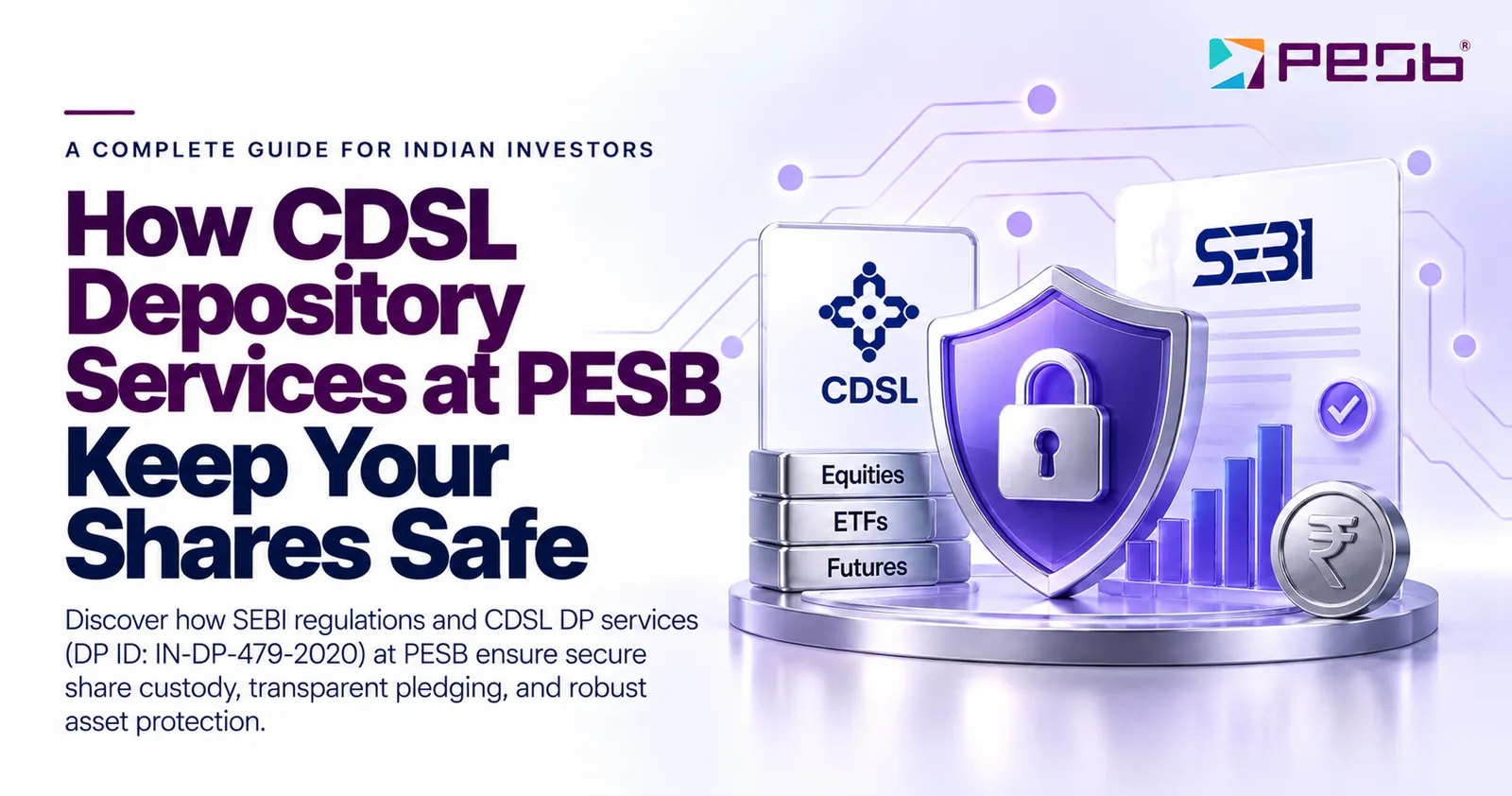
- Your BO Demat account: holds your shares in your own name and links directly to CDSL.
- CDSL central infrastructure (DP ID: IN-DP-479-2020): keeps the master record of every holding.
- SEBI regulatory guardrails: govern how the depository and the participant handle your securities.
- Execution and pledging layer: where trades settle and holdings are pledged as margin, always within those rules.
The Global Parallel: Institutional Custodial Standards
In international financial markets, retail and institutional participants look to established institutions like the Fidelity online trading platform or the Charles Schwab online trading platform for peace of mind regarding asset protection and clearing efficiency. In India, SEBI’s depository framework offers an equivalent—and in many operational facets, more transparent—regime.
While users of a Schwab online trading platform or similar global venues rely on SIPC insurance and segregated custodial accounts, Indian market participants benefit from real-time transaction verification directly from CDSL. Every credit or debit triggers immediate dual-channel SMS and email notifications directly from the depository, completely independent of the broker’s internal back-office reporting.
The Modern Pledging Mechanism: Margin Funding Without Loss of Ownership
For active market participants operating across equities and derivatives, liquidity management is everything. Traders frequently leverage existing holdings to generate margin collateral for short-term opportunities. Historically, obtaining margin required transferring shares from the client's demat account to the broker’s collateral account—a system that introduced operational risk.
In September 2020, SEBI transformed this landscape with the mandatory Margin Pledge / Margin Re-pledge (MPMR) Mechanism.
How Margin Pledging Works at PESB
Under the regulated CDSL framework at PESB:
- Retention of Ownership: Pledged shares remain inside your personal CDSL demat account. They are not transferred to the broker's pool account.
- Pledge Marking: A legal lien is placed on the specific quantity of shares approved by the client via CDSL OTP authentication.
- Corporate Actions Uninterrupted: Because the securities remain registered under your BO ID, all corporate benefits—such as cash dividends, stock splits, bonus shares, and voting rights—flow directly to you.
- Margin Generation: Once pledged, the permissible collateral value (after regulatory haircuts) is instantly updated on your trading terminal, unlocking leverage for equity delivery, intraday positions, or derivative trading on your futures online trading platform.
- Transparent Unpledging: Once your trading obligations are satisfied or positions are closed, unpledging requests release the lien smoothly back to free-balance status.
This transparent mechanism eliminates unauthorized share movements and establishes an equitable environment for both traders and risk management systems.
Utilizing ETFs in Modern Portfolios: Custody, Liquidity, and Collateral
Exchange-Traded Funds have emerged as one of the most flexible wealth-creation tools of the 21st century. Selecting an ETF as investment offers immediate diversification, low expense ratios, and the intraday trading flexibility of individual stocks.
Whether utilizing index funds tracking the Nifty 50, sector-specific themes, or international baskets, an ETF in investment portfolios functions as a vital bridge between passive indexing and active tactical allocation.
Two ways to use ETFs:
- Strategic core holding: index and gold ETFs with low tracking error, held for long-term compounding.
- Collateral generation: liquid and G-Sec ETFs pledged at a low haircut to support futures and options margin.
Strategic Advantages of ETF Investment at PESB
When holding an ETF investment through PESB’s CDSL depository participant network, investors benefit from:
- Seamless Demat Integration: Unlike traditional mutual funds which may require separate registrar folios, an investment ETF is credited directly to your CDSL BO account alongside your regular equities.
- Margin Optimization via Liquid ETFs: Advanced traders often place surplus capital into liquid or overnight ETFs. These instruments can be pledged under CDSL protocols with minimal haircuts, generating trading margins for futures contracts while continuing to earn underlying yields.
- Asset Segregation and Transparency: When you execute an investment in ETF products, real-time settlement ensures the exact units are allocated to your unique demat identifier, visible through both PESB’s back-office and CDSL’s consolidated account statement (CAS).
Whether building a multi-decade retirement nest egg or deploying tactical hedges, allocating capital toward an investment in ETF securities within a regulated depository framework maximizes efficiency and oversight.
Best Platform for Online Trading: Evaluating Speed, Research, and Custody
Choosing the best online trading platform requires looking beyond sleek visual design. Active traders and long-term investors alike must evaluate three core pillars: Execution, Intelligence, and Settlement Custody.
- Depository Integration: Low-cost platforms: Often reliant on third-party clearing / pool routing. PESB: Direct CDSL DP Participant (DP ID: IN-DP-479-2020).
- Collateral Pledging: Low-cost platforms: Batch processing with delay. PESB: Fast OTP-based CDSL Margin Pledge / Unpledge.
- Research & Advisory: Low-cost platforms: Discount model; DIY with no active guidance. PESB: Certified SEBI Research Analyst Team (INH000018197).
- Account Reporting: Low-cost platforms: Standalone broker dashboard only. PESB: Dual Verification: PESB Back-Office + CDSL Easiest / CAS.
- Support Hierarchy: Low-cost platforms: Bot-driven ticket systems. PESB: Dedicated Depository, Settlement, & Dealer Desk Support.
For participants searching for the best trading online platform, PESB combines low-latency order routing technology across NSE, BSE, MCX, and NCDEX with direct depository participant capabilities. This unified setup avoids the operational friction that occurs when trading terminals and clearing depositories operate in disjointed silos.
Transparent Asset Verification: CDSL Easiest and Consolidated Account Statements
A hallmark of an online trading best platform is complete operational transparency. SEBI and CDSL provide multiple mechanisms enabling investors to independently verify their balances without relying solely on brokerage ledger statements.
1. CDSL Easi & Easiest
CDSL offers an internet-based facility called Easi (Electronic Access to Securities Information) and Easiest (Electronic Access to Securities Information and Execution of Secured Transactions). By registering with your 16-digit BO ID (incorporating PESB's DP ID IN-DP-479-2020): applied directly via CDSL:
- You can track demat holdings, valuation changes, and transaction histories 24/7.
- You can initiate off-market transfers and inter-depository transactions via secure cryptographic authentication.
- You can inspect active margin pledges and liens in real time.
2. Consolidated Account Statement (CAS)
Under SEBI regulations, CDSL generates a monthly Consolidated Account Statement aggregating all your financial holdings—equities, demat mutual funds, debt securities, and preference shares—across all depository accounts and folios tied to your PAN. This provides a single, verifiable snapshot of your total wealth.
3. Dual-Level Transaction Alerts
Every time an order executes and settles through PESB:
- PESB generates a digital, timestamped Contract Note within 24 hours.
- CDSL sends a separate, automated SMS/email alert directly to your registered contact details confirming the exact quantity credited to or debited from your demat balance.
This rigorous check-and-balance system prevents unauthorized transactions and ensures your holdings are accounted for down to the individual share unit.
Depository Best Practices for Market Participants
To ensure your investment and trading operations remain resilient, adopt these depository safety practices:
- Keep KYC Details Updated: Ensure your active mobile number and email address are current across your PESB trading and CDSL demat accounts to receive real-time OTPs and transaction alerts.
- Enable CDSL TPIN Authentication: For non-pledged share sales where Power of Attorney (PoA) is not executed, utilize CDSL TPIN with dual OTP authentication for pre-trade authorization.
- Review Monthly Holding Statements: Cross-examine your PESB monthly holding report with your CDSL Consolidated Account Statement to maintain immaculate portfolio hygiene.
- Safeguard Margin Leverage: When pledging equities or ETFs for derivative trading, monitor price fluctuations to ensure your collateral values remain safely above required exchange maintenance margins.
The PESB Advantage: Integrated Trading, Research, and Custody
With over 17 years of market excellence, serving more than 75,000 clients across 15+ cities, Pune e Stock Broking Limited represents a modern synthesis of corporate broking strength, SEBI-registered research advisory, and direct CDSL depository services.
Whether your objective is navigating intraday volatility on a futures online trading platform, executing periodic allocations in index and thematic ETFs, or protecting family generational wealth in long-term blue chips, PESB provides the regulatory stability and technological infrastructure needed to achieve your financial objectives.
Take Control of Your Trading and Custodial Journey
Experience high-speed trade execution paired with the security of SEBI-regulated CDSL depository custody. If you have questions regarding demat setup, collateral pledging, or margin trading, contact our specialized depository support team at PESB today.
Related resources
- best online trading platform
- best platform for online trading
- best trading online platform
- online trading best platform
- online trading platform best
- etf investment
This article is for information and education only and is not investment advice. Investments in securities market are subject to market risks; read all related documents carefully before investing.