


Investing BasicsDepository and DematBy Sheilandra Singh14 min read
Depository Services Fees: Are They Worth It for Indian Investors
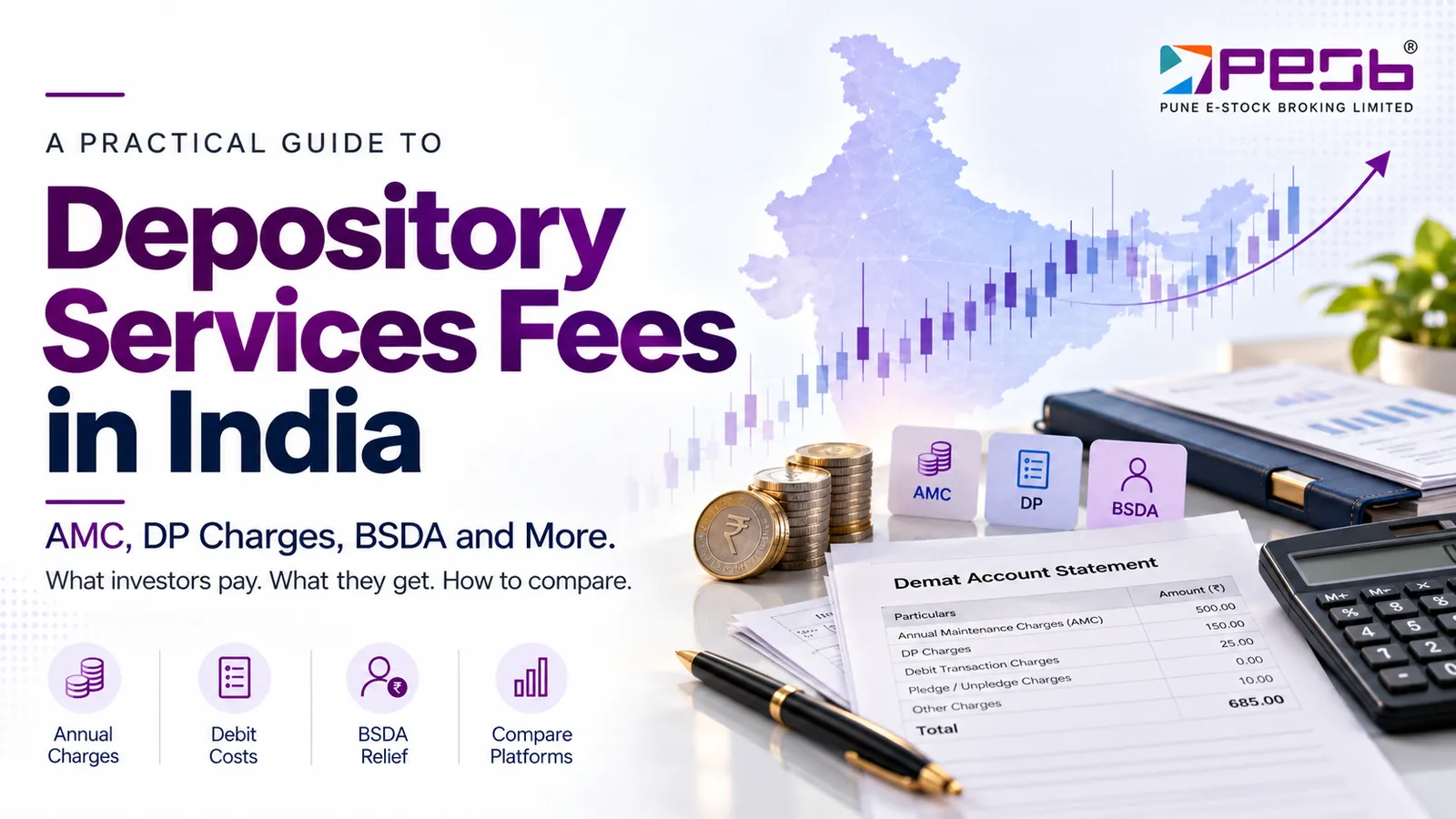
Every rupee an investor deploys into listed Indian securities ultimately comes to rest inside a dematerialised account, and that account is seldom operated free of charge. The analytically useful question is therefore not whether depository services cost money, because they demonstrably do, but whether the fee purchases verifiable ownership, orderly settlement, and a material reduction in operational risk relative to the paper certificate regime it displaced.
Key takeaways
- Depository services fees remunerate custody, electronic ownership records, settlement interfaces, corporate action processing, and audit trails, rather than mere passive storage of securities.
- SEBI's Basic Services Demat Account (BSDA) framework can reduce or eliminate annual maintenance charges for eligible small investors, which means eligibility screening should precede any comparison of headline tariffs.
- For delivery based equity investors, the recurring fee is comparatively easy to justify, whereas an account that is opened and left dormant tends to represent poor value regardless of how modest the tariff appears.
- For derivatives participants, particularly anyone operating through a futures online trading platform, pledge and unpledge charges can rival the annual maintenance charge in economic significance.
- International benchmarks such as the Fidelity online trading platform and the Charles Schwab online trading platform demonstrate that custody can be embedded within a broader brokerage relationship, which renders Indian line item fees more visible even where the underlying economic substance is comparable.
At a glance
- Core cost heads: account opening, annual maintenance charge (AMC), debit transaction charges, pledge and unpledge charges, dematerialisation, rematerialisation, and physical statement requests.
- Who bills you: the Depository Participant (DP), typically a broker or bank, while the depository maintains the central electronic register of ownership.
- Indian market structure: two depositories, NSDL and CDSL, operate under the Depositories Act framework (SEBI and Depositories Act, 1996).
- Small investor relief: BSDA eligibility can produce nil or reduced AMC for qualifying accounts, with revised thresholds notified in 2024 (SEBI circular, 2024).
- Practical verdict: the fee is defensible when the account is active, compliant, and serviced by a responsive DP, and difficult to defend when the account is dormant or the tariff is opaque.
What are depository services, and why do they charge fees?
Depository services constitute the custody and record keeping layer of the securities market. A depository holds shares, bonds, mutual fund units, and exchange traded funds in electronic form, while a Depository Participant opens and services the investor's demat account. The fee finances ownership records, settlement interfaces, reconciliation, security controls, and grievance redressal.
India's depository architecture was constructed to supplant physical certificates with electronic book entries under the Depositories Act framework (SEBI and Depositories Act, 1996). That legislative transition carries continuing significance because an investor's claim on a security is no longer a bundle of paper in a drawer; it is an entry within a regulated system that must reconcile continuously with exchanges, clearing corporations, registrars, and issuing companies.
The investor ordinarily does not pay NSDL or CDSL directly. The DP invoices the client and recovers its own operating expenditure plus depository levied charges through a published tariff sheet. PESB, for instance, operates as a CDSL Depository Participant with DP ID IN-DP-479-2020, which means client holdings are recorded with CDSL while PESB administers servicing, custody requests, and share transfer instructions (PESB website, accessed 2025).
The most instructive way to conceptualise the charge is as a combination of insurance and plumbing. It does not select securities, and it generates no excitement, yet it keeps the ownership chain legible whenever an investor buys, sells, pledges, transmits, or relocates holdings between accounts.
A demat account reduces theft, forgery, bad delivery, and loss risks associated with paper certificates by keeping ownership electronic (SEBI investor education material, 2023).
Share on LinkedIn · Share on X
Which demat account charges appear on a tariff sheet?
An investor should expect a disclosed schedule of charges rather than a single consolidated fee. The principal heads are account opening, annual maintenance charge, debit transaction charges levied when securities exit the account, pledge related charges, and incidental requests such as dematerialisation or physical statements. The precise quantum must be sourced from the DP's current tariff sheet, not from any generic estimate.
A disciplined investor reads the schedule of charges before electronically signing the account opening documentation. The tariff sheet is not fine print in the casual sense; it functions as the price list for custody, transfers, failed instructions, and exceptional requests. When a DP cannot produce the schedule promptly and clearly, that difficulty is itself an informative signal about service quality.
A useful review checklist for any online trading platform that bundles broking with demat services includes the following items:
- Opening charge: frequently waived during promotional campaigns, although the investor should confirm whether the waiver is permanent or restricted to the first year.
- Annual maintenance charge: the recurring fee for keeping the demat account operational, sometimes billed annually and sometimes quarterly, and occasionally scaled to the value of holdings.
- Debit charge: applied whenever shares move out of the account, most visibly after delivery based selling or an off market transfer.
- Pledge and unpledge charge: relevant when holdings are offered as collateral for margin, a matter of central importance for derivatives traders.
- Dematerialisation and rematerialisation: conversion of physical certificates to electronic form, or the reverse, each attracting per request or per certificate fees.
- Incidental items: physical statement requests, delivery instruction slip reissue, failed instruction penalties, and charges arising from incorrect payee details.
The appropriate comparison is never the AMC in isolation. An investor who sells delivery positions frequently, or who pledges holdings routinely for margin, should aggregate the full year's projected charges under each DP's tariff before drawing any conclusion about which arrangement is cheaper.

How does the BSDA framework reduce costs for small investors?
The Basic Services Demat Account, introduced by SEBI and subsequently revised, entitles eligible small investors to nil or capped annual maintenance charges once the value of holdings falls below notified thresholds. Under the framework revised in 2024, holdings valued up to four lakh rupees attract nil AMC, and holdings between four and ten lakh rupees attract a capped charge (SEBI circular, 2024).
Eligibility is conditional rather than automatic. The BSDA is intended for an individual who is the sole or first holder, who maintains only one demat account across all depository participants, and whose holdings remain within the stipulated value bands. Where an investor holds multiple accounts, or where the portfolio appreciates beyond the upper threshold, the account converts to a regular demat account and the standard tariff applies.
Two practical implications follow. First, a first generation investor assembling a modest equity or exchange traded fund portfolio may legitimately pay nothing for custody, provided the account is flagged as a BSDA and the eligibility conditions continue to be satisfied. Second, the onus of verification sits with the investor: depository participants are expected to extend the facility, but investors should confirm the account's classification on the statement and raise the matter with the DP if the correct tariff has not been applied. Escalation channels exist for precisely this situation, including the depository's own grievance portal and SEBI's SCORES platform (SEBI SCORES, accessed 2025).
Are depository fees worth it for delivery investors and SIP users?
For delivery based equity investors, the fee is generally defensible because each purchase culminates in a credit to the demat account, each sale triggers a debit, and corporate actions such as dividends, bonus issues, and splits are processed through the same custody chain. The annual charge amortised across genuine activity typically represents a negligible fraction of portfolio value.
The calculation becomes more nuanced for mutual fund investors who build portfolios through systematic investment plans. Mutual fund units can be held either in demat form, where they occupy the same custody infrastructure as shares, or in statement of account form held directly with the registrar, where no demat charge arises at all. An investor evaluating long term wealth creation with a SIP investment plans calculator should recognise that such calculators project corpus growth from contribution, tenure, and assumed return, while excluding custody costs entirely. A recurring AMC of even a few hundred rupees, compounded against a small SIP portfolio over two decades, is a drag the calculator will never display.
This produces a clean decision rule. Mutual fund only investors who never transact in listed securities may rationally prefer the statement of account route and avoid demat charges altogether. Hybrid investors who combine SIP portfolios with direct equity, IPO applications, and exchange traded funds will usually find that a single consolidated demat account justifies its AMC through administrative convenience, consolidated reporting, and the ability to pledge or transfer holdings without friction.

How do depository charges affect futures and margin traders?
Derivatives participants interact with depository services differently, because their central concern is collateral rather than custody alone. Since SEBI mandated the pledge and repledge mechanism for margin in 2020, traders routinely pledge demat holdings to obtain trading limits, and each pledge or unpledge instruction can attract a per transaction DP charge (SEBI margin framework, 2020).
For an active user of a futures online trading platform, these transaction levies accumulate in ways the headline AMC conceals. A trader who pledges a liquid fund or blue chip portfolio at the start of each expiry cycle, invokes and releases margin repeatedly, and occasionally faces an unpledge request during risk management will generate a stream of small debits that can exceed the annual maintenance charge several times over. The economically meaningful comparison for such a trader is therefore the pledge tariff, the speed with which the DP processes unpledge instructions, and the reliability of the collateral reporting, rather than the nominal annual fee.
This is also where service quality acquires monetary value. A delayed unpledge can leave collateral locked precisely when a trader needs to liquidate or reallocate, and a failed instruction penalty is a direct cost. Evaluating depository services purely on the cheapest AMC ignores the operational dimension that matters most to leveraged participants.
What can Indian investors learn from Fidelity and Charles Schwab?
American brokerage economics offer a revealing contrast. The Fidelity online trading platform and the Charles Schwab online trading platform both eliminated commissions on online United States equity trades in 2019, and neither presents retail customers with a visible custody invoice of the Indian kind (company announcements, 2019). Custody and record keeping costs are absorbed within a wider revenue model built on net interest income, fund distribution fees, securities lending, and order routing economics.
The lesson is not that American custody is free in any absolute sense; it is that the cost has been rendered invisible by being embedded elsewhere in the relationship. Indian investors, by contrast, confront an itemised tariff in which custody, debit transactions, and pledging each carry an explicit price. That transparency is arguably advantageous, because it permits direct comparison between depository participants, and SEBI's framework obliges disclosure in a manner that bundled foreign models do not replicate.
For the Indian investor, the practical takeaway is twofold. First, a visible AMC of a few hundred rupees should not be dismissed as poor value merely because a foreign platform appears to charge nothing; the economic question is total cost of ownership across brokerage, custody, and incidental levies. Second, where an online trading platform advertises zero or near zero charges, the prudent response is to locate where custody economics have been relocated, whether into wider spreads, fund platform fees, or charges on adjacent products.
How should you compare online trading platforms on custody costs?
A rigorous comparison aggregates every foreseeable charge under a realistic activity profile, rather than fixating on whichever single number a platform chooses to advertise. The same investor can arrive at opposite rankings depending on whether the profile assumes two delivery sales a year or two hundred pledge instructions.
A workable evaluation procedure runs as follows:
- Obtain the complete tariff sheet from each shortlisted DP, including incidental and penalty heads, and note the revision history if it is published.
- Model the activity profile: estimate annual delivery debits, pledge and unpledge instructions, corporate action volumes, and any anticipated dematerialisation or transmission requests.
- Test BSDA eligibility before comparing standard tariffs, because a qualifying investor may face no AMC at all under the 2024 thresholds (SEBI circular, 2024).
- Assess service infrastructure: turnaround times for unpledge and off market transfers, the escalation matrix, and the quality of statements and contract notes.
- Verify regulatory standing: confirm the DP's registration, the depository affiliation (NSDL or CDSL), and the published grievance channel before committing.
PESB's own structure illustrates what this diligence looks like in practice: the firm is a CDSL Depository Participant (DP ID IN-DP-479-2020), maintains a department level contact directory for custody, pledging, and settlement queries, and publishes a depository services escalation matrix that runs from client servicing through the compliance officer to a director, with SEBI SCORES as the terminal avenue (PESB website, accessed 2025). Whatever DP an investor ultimately selects, the existence of that kind of documented escalation path is worth weighting alongside the tariff itself. Readers who want to understand how a full service broking house frames its regulatory credentials can review the PESB background and registrations for a concrete example.
What this means for you
If you invest through delivery based equity purchases, the depository fee is almost certainly worth paying, because you are buying a legally enforceable electronic title, seamless settlement, and automatic processing of corporate actions for a sum that is trivial relative to portfolio value.
If you are a small or first time investor, your first action is not to negotiate the tariff but to check BSDA eligibility, since the 2024 framework may reduce your custody cost to nil provided you hold a single account within the threshold bands.
If you trade derivatives, redirect your attention from the AMC to the pledge and unpledge tariff and to processing reliability, because those variables, not the annual fee, determine your real custody cost on a futures online trading platform.
If your portfolio consists exclusively of mutual fund SIPs, consider whether the statement of account route serves you at zero custody cost, and treat any SIP investment plans calculator projection as incomplete until you have netted out whichever holding structure you choose.
Finally, if your existing account is dormant, either close it formally or reactivate it deliberately; an idle demat account delivers none of the custody benefits while continuing to accrue charges, which is the one configuration in which depository fees are unambiguously not worth it.
For a tariff discussion grounded in your actual activity profile, the PESB client servicing team can walk through the schedule of charges, BSDA eligibility, and pledge related costs before you commit.
Frequently asked questions
Are depository services fees tax deductible for Indian investors?
Demat and depository charges are generally treated as part of the cost of acquiring or transferring securities rather than as a separately deductible expense for salaried investors. Where they are connected to a transfer, they may be factored into the cost of acquisition or transfer computation for capital gains purposes. Tax treatment depends on individual circumstances, so confirmation with a tax adviser is advisable.
Can I hold mutual fund SIP investments without paying any demat charges?
Yes. Mutual fund units can be held in statement of account form directly with the registrar, in which case no demat account is required and no AMC arises. The trade off is that holdings remain outside the consolidated demat view and cannot be pledged as conveniently for trading margin.
What happens to my holdings if a depository participant shuts down?
Your securities remain recorded at the depository level, with NSDL or CDSL, rather than with the DP itself. You can transfer the account to another participant without liquidating holdings, which is one of the structural protections the depository model was designed to provide.
How do I check whether my account is classified as a BSDA?
The classification appears on your demat account statement, and the DP is required to apply the BSDA tariff where eligibility conditions are met. If the correct classification is missing, raise the matter with the DP's client servicing desk and escalate to the depository or SEBI SCORES if it remains unresolved.
Is a zero AMC offer from an online trading platform genuinely free?
Sometimes the waiver is permanent, but frequently it applies only to the first year or excludes incidental heads such as pledge, debit, and failed instruction charges. The reliable test is the complete tariff sheet combined with your own projected activity, rather than the advertised headline.
Related resources
- depository services
- online trading platform
- sip investment plans calculator
- futures online trading platform
- fidelity online trading platform
- charles schwab online trading platform
- demat account charges
- BSDA
- CDSL
- NSDL
This article is for information and education only and is not investment advice. Investments in securities market are subject to market risks; read all related documents carefully before investing.