
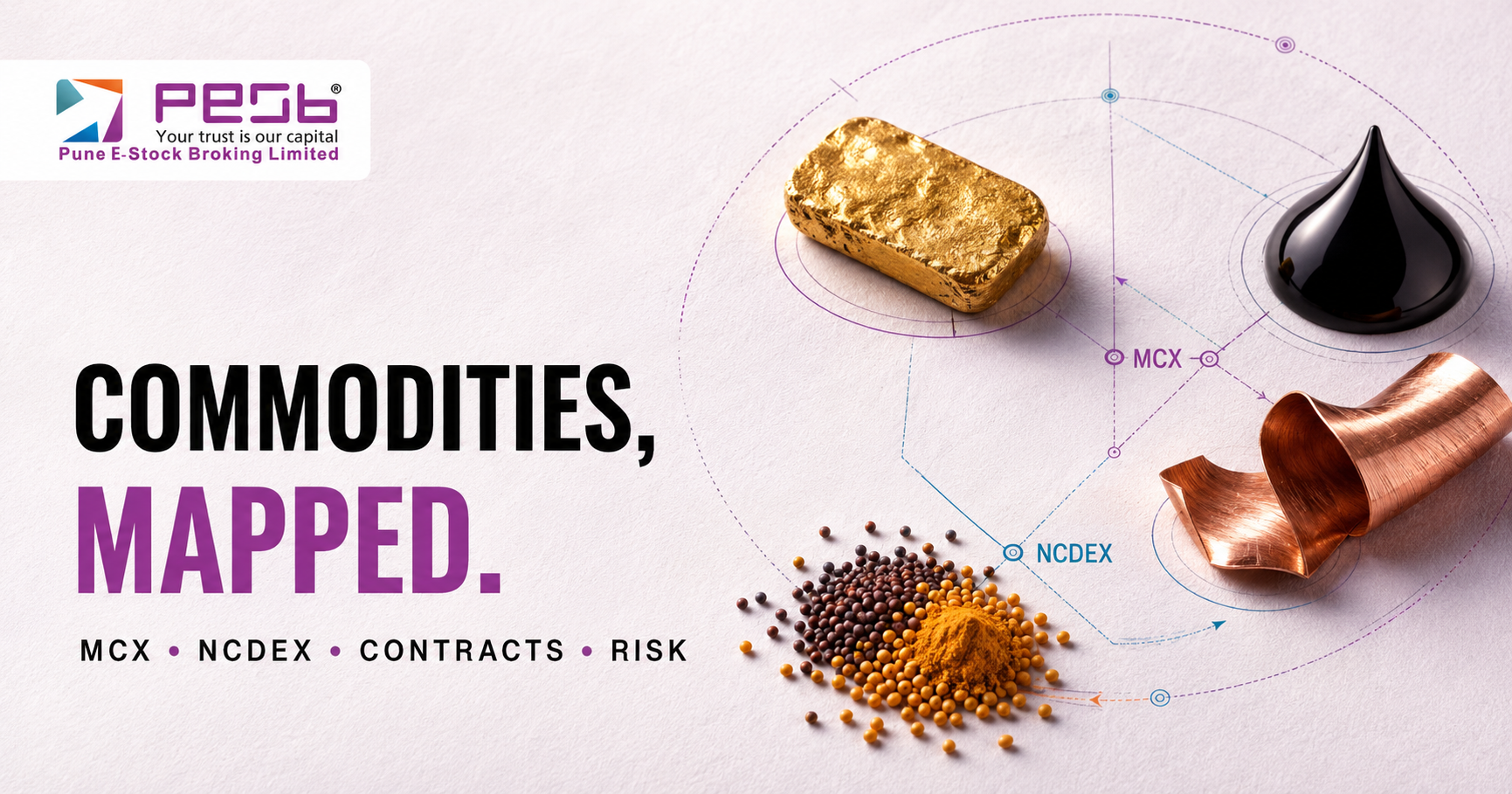
Commodity trading is one of the oldest forms of commerce in the world, yet in modern financial markets, it offers some of the most dynamic opportunities for hedging, portfolio diversification, and active market participation. For Indian investors and traders looking beyond traditional equities and fixed income, commodities traded on domestic bourses provide a direct avenue to participate in global economic trends, industrial cycles, and agricultural seasons.
Understanding how derivative contracts work across leading commodity exchanges—primarily the Multi Commodity Exchange (MCX) and the National Commodity & Derivatives Exchange (NCDEX)—is essential for anyone seeking to build a resilient, multi-asset portfolio. Partnering with an experienced corporate broking house like Pune e Stock Broking Limited (PESB) ensures that traders have the research insights, execution speed, and risk management systems needed to navigate these fast-moving markets.

Understanding the Commodity Ecosystem in India
In India, commodity derivatives are regulated by the Securities and Exchange Board of India (SEBI). Commodity exchanges allow market participants—ranging from retail traders and high-net-worth individuals to commercial hedgers, importers, exporters, and value chain participants—to trade standardized futures and options contracts on physical assets.
Unlike equity markets where trading represents ownership in a corporate entity, commodity contracts derive their value directly from underlying raw materials and physical goods. These are broadly categorized into two major exchange ecosystems:
- Multi Commodity Exchange of India (MCX): The nation’s premier exchange for non-agricultural commodities, including bullion (gold and silver), base metals (copper, zinc, aluminum, lead, nickel), and energy contracts (crude oil and natural gas).
- National Commodity & Derivatives Exchange (NCDEX): India’s leading exchange focused on agricultural commodities, facilitating price discovery and risk management for crops such as spices, pulses, oilseeds, and grains.
By engaging in PESB commodity broking, traders access integrated market connectivity across MCX and NCDEX, backed by robust analytical support and seamless order routing technology.
Core Commodity Segments: Bullion, Energy, Base Metals, and Agri
To build effective trading strategies, it is critical to understand the unique demand-supply drivers and global macroeconomic factors that govern each commodity asset class.
+-----------------------------------------------------------------------------------+
|                         MAJOR COMMODITY MARKET SEGMENTS                           |
+-----------------------+-----------------------+-----------------+-----------------+
| Bullion               | Energy                | Base Metals     | Agri Commodities|
| (MCX)                 | (MCX)                 | (MCX)           | (NCDEX)         |
+-----------------------+-----------------------+-----------------+-----------------+
| * Gold (Standard,     | * Crude Oil (Main &   | * Copper        | * Spices (Jeera,|
|   Mini, Guinea, Petal)|   Mini)               | * Aluminium     |   Turmeric)     |
| * Silver (Standard,   | * Natural Gas (Main & | * Zinc          | * Oilseeds &    |
|   Mini, Micro)        |   Mini)               | * Lead          |   Guar Complex  |
|                       |                       |                 | * Grains/Pulses |
| Inflation hedge, safe | OPEC+ policies, geo-  | Global infra &  | Monsoon patterns|
| haven asset           | politics, demand data | industrial cycle| MSP, crop yields|
+-----------------------+-----------------------+-----------------+-----------------+
1. Bullion: Gold and Silver as Safe-Haven Anchors
Bullion has historically served as a hedge against currency debasement, high inflation, and geopolitical uncertainty. On the MCX platform, gold and silver are available in multiple contract sizes tailored for different capital allocations:
- Gold Contracts: Standard Gold (1 kg), Gold Mini (100 grams), Gold Guinea (8 grams), and Gold Petal (1 gram).
- Silver Contracts: Standard Silver (30 kg), Silver Mini (5 kg), and Silver Micro (1 kg).
Bullion prices on MCX reflect spot prices in international hubs (such as London and COMEX), adjusted for import duties, goods and services tax (GST), and the USD/INR exchange rate. Market participants monitor US Federal Reserve monetary policy, inflation figures (CPI/PCE), and real interest rates to identify directional trends in bullion.
2. Energy: Crude Oil and Natural Gas
Energy commodities represent the lifeblood of global economic output. Traders actively track contracts on MCX due to their high liquidity and intraday volatility:
- Crude Oil: Derived from international benchmarks (such as Brent and WTI), crude oil futures respond rapidly to OPEC+ output decisions, global inventory levels (like the US EIA weekly petroleum status report), and geopolitical developments in producing regions.
- Natural Gas: Natural gas prices fluctuate heavily based on seasonal weather patterns (heating demand during winter, cooling demand during summer), storage inventory reports, and export terminal dynamics.
3. Base Metals: Industrial Growth Indicators
Base metals—including copper, zinc, aluminum, and lead—are closely correlated with global industrial production, construction activity, and technological transitions (such as renewable energy and electric vehicles). Copper, often dubbed “Doctor Copper” due to its ability to diagnose global economic health, responds strongly to manufacturing PMI data from major economies and international inventory levels reported by the London Metal Exchange (LME).
4. Agri Commodities on NCDEX: Monsoon, Yields, and Domestic Demand
Agricultural commodity trading on NCDEX provides critical market mechanisms for India's farm economy. Key traded contracts include spices (jeera, turmeric, coriander), oilseeds (castor seed, soybean), and guar complex (guar seed, guar gum).
Unlike non-agri commodities influenced primarily by global liquidity, agri commodities are driven by:
- South-West and North-East monsoon progress and rainfall distribution
- Sowing acreage and production estimates released by the Ministry of Agriculture
- Government policies, Minimum Support Prices (MSP), and export/import tariffs
- Seasonal harvesting cycles and physical mandi arrivals
Derivatives Contracts: How Futures and Options Work
Trading in commodity markets primarily occurs via standardized derivative instruments rather than physical spot delivery for retail participants.
Commodity Futures
A futures contract is an agreement to buy or sell a specified quantity of a commodity at a predetermined price on a future date. Key elements include:
- Contract Specifications: Each contract defines the lot size, tick size (minimum price movement), trading hours, and expiry cycle.
- Margin Requirements: Traders do not pay the full contract value upfront; instead, they post an initial margin (SPAN margin plus exposure margin), allowing leveraged exposure.
- Mark-to-Market (MTM) Settlement: Profits and losses are calculated and settled daily against closing prices, requiring accounts to maintain sufficient maintenance margin to avoid liquidation.
Commodity Options
Commodity options provide the buyer the right, but not the obligation, to buy (Call Option) or sell (Put Option) an underlying futures contract or commodity at an agreed strike price. In India, options on commodity futures (such as Gold, Crude Oil, and Natural Gas options) have gained substantial traction due to their predefined risk profile for option buyers, requiring only premium payment rather than full margin requirements.
Hedging Commodity Risks for Businesses and Market Participants
One of the primary economic functions of MCX and NCDEX is enabling commercial entities to lock in prices and mitigate adverse market movements. Price uncertainty can disrupt profit margins for jewelers, manufacturers, agro-processors, and import-export houses.

Hedging Scenarios
- Short Hedge (Producers / Inventory Holders): A jeweler holding substantial gold inventory or a farmer holding harvested spices fears a drop in market prices before sale. By selling (shorting) futures contracts on MCX or NCDEX, any drop in the physical spot price is offset by gains in the short derivative position.
- Long Hedge (Consumers / Manufacturers): A manufacturing firm requiring large quantities of copper or an airline monitoring jet fuel costs expects prices to rise. By buying (going long on) futures contracts, the company locks in procurement costs, safeguarding future profit margins.
PESB assists institutional clients and corporate treasuries in structuring tailored hedging commodity risks frameworks to protect balance sheets from raw material price volatility.
Evaluating Online Platforms for Commodity and Multi-Asset Trading
Executing trades effectively requires an advanced technological infrastructure. Modern traders need a dependable online platform for trading that provides low latency, deep charting tools, comprehensive risk analytics, and cross-device accessibility.
Critical Features of a Leading Trading Platform
When choosing a modern platform for online trading, market participants should look for several core capabilities:
- Real-Time Market Depth & Feeds: Seamless streaming of Level 2 and Level 3 data feeds for accurate price discovery across MCX and NCDEX contracts.
- Advanced Technical Charting: Integrated technical indicators (RSI, MACD, Bollinger Bands, Volume Profile) and multi-timeframe analysis.
- Algorithmic & Bracket Orders: Stop-loss market orders, cover orders, and trailing stop features to manage intraday risk automatically.
- Multi-Asset Portfolio Dashboard: An integrated interface that allows seamless switching between commodity derivatives, equity cash, futures, options, and currency segments.
- Robust Security & Regulatory Compliance: Two-factor authentication (2FA), encrypted data transmission, and compliance with SEBI and exchange cybersecurity directives.
PESB delivers a modern online trading platform ecosystem designed for both rapid intraday execution and systematic positional strategies, ensuring fast order routing and transparent reporting. Whether you are exploring an online trading platform forex comparison or a trading platform online for commodities, PESB keeps your execution consolidated under one regulated, SEBI-compliant environment—unlike unverified forex online trading platform providers operating outside domestic oversight.
Commodities vs. Multi-Asset Investing: Equities, ETFs, SIPs, and Depository Services
While active commodity trading provides short-to-medium-term alpha and risk mitigation, disciplined long-term wealth creation relies on a holistic, multi-asset allocation strategy.
| Asset Class / Instrument | Primary Purpose | Market Drivers | Horizon | Regulatory / Custodial Frame |
|---|---|---|---|---|
| Commodity Futures & Options | Hedging, tactical trading, inflation protection | Global demand/supply, OPEC, geopolitical tension, weather | Intraday to Multi-Month | SEBI / MCX & NCDEX Exchanges |
| Equity Shares & Index Funds | Long-term capital appreciation, corporate growth | Corporate earnings, GDP growth, macroeconomic expansion | Multi-Year (3 to 10+ Years) | SEBI / CDSL & NSDL Depositories |
| Mutual Fund SIPs | Rupee-cost averaging, systematic compounding | Broad market indices, sector momentum | Long-Term (5 to 15+ Years) | AMFI / Asset Management Companies |
| Global & Commodity ETFs | Thematic diversification, passive asset tracking | Underlying physical assets (Gold, Silver, Tech indices) | Medium to Long-Term | Stock Exchanges / Depository Participants |
Integrating Systematic Investment Plans (SIPs)
Many traders use the profits generated from tactical commodity trading to fund long-term equity portfolios. Utilizing tools like a systematic sip investment plans calculator allows market participants to visualize compounding returns over decades, balancing high-frequency derivative risk with steady equity growth.
Exchange Traded Funds (ETFs)
For passive exposure to specific sectors or international benchmarks—similar to how global investors access tech-heavy or thematic baskets via instruments like a fidelity investment etf—domestic investors can utilize Gold ETFs, Silver ETFs, and equity indices traded on the NSE and BSE. These instruments eliminate physical storage overhead while mirroring underlying asset prices.
Role of Depository Participants
When holding equities, ETFs, and mutual fund units, safe custodial infrastructure is paramount. In India, central depository institutions maintain electronic records of investor holdings. The operational growth of institutions reflected in market barometers like the central depository services share price underscores the broader formalization and digital expansion of retail investing across India.
Global Trading Nuances: Commodities vs. Forex
Traders exploring leveraged instruments often compare domestic commodities to international currency markets. In India, retail currency derivative trading on domestic exchanges (NSE, BSE) is strictly regulated under RBI and SEBI guidelines, restricted to approved currency pairs (such as USDINR, EURINR, GBPINR, JPYINR). Traders should be cautious of unauthorized offshore forex online trading platform entities that operate outside Indian regulatory oversight. Traded through an authorized domestic broker, MCX and NCDEX commodity contracts provide a fully regulated, transparent, and legally protected trading environment.
Practical Risk Management Strategies for Commodity Traders
Commodity markets can experience sharp intraday swings driven by unexpected news events, inventory prints, or currency shifts. Successful market participants operate with disciplined risk management rules:
+-----------------------------------------------------------------------------------+
|                         PILLARS OF RISK MANAGEMENT                                |
+-----------------------------------------------------------------------------------+
| 1. Position Sizing: Cap exposure per trade to 1-2% of overall account equity.     |
| 2. Hard Stop-Losses: Always predefine exit points before triggering order entry.   |
| 3. Margin Buffering: Maintain liquid cash reserves above exchange margin minimums.|
| 4. Expiry Vigilance: Monitor staggered tender periods to prevent physical delivery|
|    obligations on deliverable contracts.                                          |
| 5. Multi-Asset Balance: Combine active derivatives with passive equity holdings.  |
+-----------------------------------------------------------------------------------+
- Predefined Position Sizing: Never risk more than a small percentage (typically 1–2%) of your total trading capital on any single commodity contract. Leverage can amplify gains, but it multiplies losses equally fast.
- Strict Stop-Loss Discipline: Use system-enforced stop-loss orders rather than mental stops to eliminate emotional decision-making during high-volatility events.
- Monitoring Tender & Delivery Periods: Certain MCX and NCDEX contracts enter a tender period prior to expiry, where open positions may result in physical delivery obligations. Traders intending to settle purely in cash must roll over or square off contracts before the tender window opens.
- Tracking Global Economic Calendars: Keep track of weekly inventory releases (EIA crude oil and natural gas reports), central bank policy meetings (US FOMC, RBI MPC), and agricultural crop forecasts.
Why Trade Commodities with Pune e Stock Broking Limited (PESB)?
Established in 2007, Pune e Stock Broking Limited (PESB) is a corporate broking house serving over 75,000 clients across India. With memberships across major exchanges—NSE, BSE, MCX, and NCDEX—and SEBI Research Analyst registration (Reg. No: INH000018197), PESB provides the institutional-grade tools and personalized guidance required for modern commodity trading MCX and NCDEX agri trading participation.
- Comprehensive Market Access: Trade bullion, energy, metals, and agricultural commodities alongside equities, derivatives, IPOs, and mutual funds from a single corporate partner.
- Speed & Execution: High-speed order routing systems ensure rapid trade execution in volatile commodity markets.
- Research-Backed Decisions: Daily technical and fundamental research reports provide clear market trend analysis and actionable setups.
- Dedicated Client Support: Access a responsive escalation matrix and dedicated dealer desks for order assistance and depository support.
Conclusion: Accelerate Your Commodity Trading Journey
Whether you are looking to hedge physical raw material risks, diversify away from equities, or capitalize on short-term price momentum across gold, crude oil, base metals, and spices, commodity derivatives on MCX and NCDEX provide an unmatched trading arena. Success requires solid foundational knowledge, systematic risk discipline, and a reliable broking partner.
Ready to get started with institutional-grade research and execution technology? Get in touch with the PESB team today to open your commodity trading account and access India's premier derivative markets.