
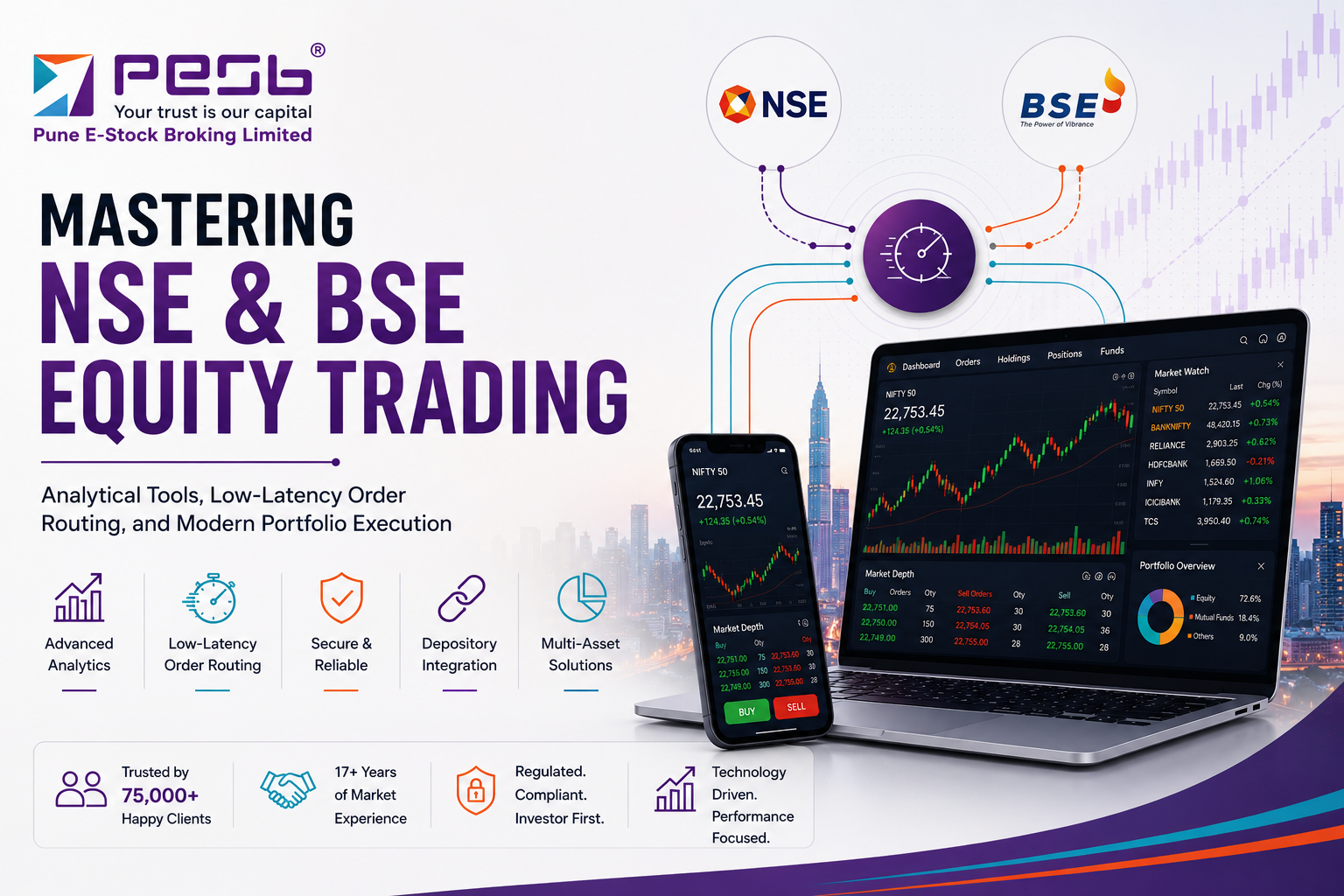
The Indian capital market landscape has undergone a dramatic technological transformation over the past decade. With retail participation reaching historic highs and institutional trading volumes expanding rapidly, the modern trader and investor can no longer rely on sluggish portals or disjointed market feeds. Operating simultaneously across India’s primary exchanges—the National Stock Exchange (NSE) and the Bombay Stock Exchange (BSE)—demands millisecond-level precision, deep analytical capabilities, and dependable market infrastructure.
Whether executing high-frequency intraday swing trades or building a multi-decade wealth compounding portfolio, the bridge between market opportunity and profitable realization is your broker’s technical execution stack. Pune E Stock Broking (PESB), established in 2007 and backed by over 17 years of institutional experience, combines advanced market infrastructure with SEBI-registered research advisory to deliver high-performance NSE BSE equity trading.
The Mechanics of Rapid Order Routing in Stock Market Execution
In capital markets, price discovery is continuous and volatile. An equity traded on both the NSE and BSE may experience micro-discrepancies in bid-ask spreads, order book depth, and liquidity volume throughout the trading day. For traders, the quality of stock market execution directly dictates net profitability.
+-------------------------------------------------------------------------+
|                        PESB Order Routing Layer                         |
|                                                                         |
|    [ Direct Market Data Feeds ] <---> [ Smart Routing Engine ]          |
|                   |                                 |                   |
|                   v                                 v                   |
|        NSE Co-location Gateway           BSE FAST Gateway               |
|                   |                                 |                   |
|                   +---------> Low Latency <---------+                   |
|                                    |                                    |
|                        [ CDSL Depository Bridge ]                       |
+-------------------------------------------------------------------------+
1. Smart Order Routing and Latency Reduction
Smart order routing architecture evaluates live quotes across both exchanges before sending an order packet. When an order is placed on an advanced online platform for trading, the underlying engine analyzes:
- Exchange Liquidity: Which exchange has greater depth at your desired limit or market price.
- Slippage Control: Minimizing the difference between expected price and realized execution price.
- Turnaround Latency: Compressing the round-trip time between client order input, risk management checks, exchange gateway submission, and receipt confirmation.
2. Eliminating Execution Bottlenecks
During high-volatility events—such as Union Budget announcements, monetary policy updates, or corporate earnings releases—conventional retail servers often face bandwidth congestion. PESB’s dedicated trading infrastructure is built to absorb extreme message volumes without queue freezing, ensuring that stop-loss triggers, limit orders, and bracket strategies execute when market conditions demand them.
Anatomy of a Modern Share Trading Platform
An effective share trading platform is much more than an order-placement terminal; it is a full-fledged financial cockpit. Modern market participants require an intuitive online trading platform that harmonizes technical charting, real-time news aggregation, and instantaneous risk management.

Core Pillars of a High-Performance Trading Platform Online
| Feature Dimension | Typical Retail Broker Portal | PESB Advanced Trading Environment |
|---|---|---|
| Exchange Access | Single-window basic feeds | Synchronized NSE & BSE dual-exchange order books |
| Order Routing | Standard server queuing | Low-latency, optimized direct routing architecture |
| Analytical Depth | Basic moving averages | Multi-timeframe technical indicators, depth ladders, fundamental screeners |
| Research Backing | Automated third-party algorithms | In-house SEBI Registered Research Analysts (Reg: INH000018197) |
| Depository Integration | Outsourced / multi-tier delays | Direct CDSL Depository Participant (DP ID: IN-DP-479-2020) |
| Multi-Asset Support | Siloed product silos | Equities, Derivatives, Commodities (MCX/NCDEX), Mutual Funds, ETFs |
Selecting the right platform for online trading requires examining stability, interface speed, charting capabilities, and responsive back-office support. When utilizing an integrated trading platform online, traders gain access to multi-monitor layouts, custom watchlists across industries, and direct depth-of-market (DOM) visualization.
Analytical Tools: Turning Market Noise into Actionable Trade Setups
Data without contextual analysis leads to cognitive overload. In active equity markets, successful participants rely on structured methodologies that bridge technical timing with fundamental strength.
1. Technical Screening and Volume-Profile Analysis
Modern equity traders utilize advanced online platform trading tools to identify price breakouts before momentum fades. Essential analytical modules include:
- Volume-Weighted Average Price (VWAP): Tracking institutional execution benchmarks.
- Relative Strength Index (RSI) & MACD Divergence: Spotting momentum exhaustion in overbought or oversold territories.
- Order Book Heatmaps: Visualizing pending bid and ask clusters to locate genuine institutional support and resistance zones.
2. Fundamental Research and Corporate Broking Expertise
While intraday setups benefit from price action, swing trades and long-term allocations require fundamental backing. Through PESB’s corporate research division, clients receive curated market trend evaluations, quarterly earnings breakdowns, and balance-sheet assessments. This ensures that every investment decision is backed by sound economic fundamentals rather than speculative market sentiment.
Depository Services and the Settlement Backbone: Understanding CDSL Integration
When trading equities across Indian exchanges, execution is only the first stage of the transaction lifecycle; clearing, settlement, and custodial custody are equally crucial. Every share purchased on NSE or BSE must be held electronically in a secure demat account managed by a registered Depository Participant.
The Role of Central Depository Services (CDSL)
PUNE E STOCK BROKING LIMITED operates as a certified Depository Participant with Central Depository Services (India) Limited under DP ID IN-DP-479-2020. CDSL plays an indispensable role in safeguarding digital securities, facilitating corporate action disbursements, and enabling instantaneous share pledging for margin trading facilities.
Investors frequently monitor market infrastructure leaders—such as tracking the central depository services share price on the exchange—as an indicator of capital market expansion and retail demat account growth across the country. As demat adoption broadens across Tier-2 and Tier-3 cities, PESB provides clients with streamlined depository operations, rapid pledge/unpledge approvals, and automated delivery settlement.
Long-Term Wealth Accumulation: SIP Calculators, Index Funds, and Global ETF Models
While direct equity trading on NSE and BSE appeals to active traders, long-term wealth creation often benefits from systematic, rule-based allocations. A balanced wealth creation strategy combines tactical equity positions with systematic passive investments.
+-------------------------------------------------------------------------+
|                    Holistic Wealth Portfolio Framework                  |
|                                                                         |
|   [ Direct Equities ]        [ Systematic Mutual Funds ]     [ ETFs ]   |
|   - NSE/BSE Bluechips        - Monthly SIP Allocations       - Thematic |
|   - Mid-cap High Growth      - Compounding Growth Tools      - Index    |
|             |                            |                       |      |
|             +----------------------------+-----------------------+      |
|                                          |                              |
|                       [ PESB Consolidated Back-Office ]                 |
+-------------------------------------------------------------------------+
1. Harnessing the Power of a SIP Investment Plans Calculator
Systematic Investment Plans (SIPs) allow investors to navigate market volatility through rupee-cost averaging. Utilizing a sip investment plans calculator helps investors model realistic long-term outcomes based on:
- Expected Annualized Rate of Return (r)
- Investment Horizon (n years)
- Monthly Contribution (P)
The fundamental compounding formula underpinning systematic calculations illustrates how regular increments expand exponential returns over multi-decade cycles:
M = P × [ ((1 + i)^n − 1) / i ] × (1 + i)
Where M represents the maturity amount, P is the periodic installment, i is the periodic interest rate, and n is the total number of installments.
Using an intuitive calculator enables investors to visualize whether a monthly allocation of ₹10,000, ₹25,000, or ₹50,000 aligns with their retirement, estate planning, or milestone goals.
2. Exchange-Traded Funds (ETFs) and International Benchmarks
Exchange-Traded Funds offer intraday liquidity combined with broad-market diversification. In global markets, leading asset managers have pioneered benchmark index tracking—such as the widely recognized fidelity investment etf structures that allow investors to track thematic sectors, large-cap indices, and fixed-income baskets with ultra-low expense ratios.
In the Indian market, PESB allows investors to trade domestic index ETFs (such as Nifty 50, BSE Sensex, and Nifty Bank ETFs), gold ETFs, and global feeder instruments directly on the exchange terminal alongside individual stock holdings.
Exchange-Traded Currency vs. Unregulated Forex Trading Platforms
Modern market participants frequently explore multi-asset diversification, including currency and foreign exchange markets. However, it is essential to understand the structural and regulatory distinctions in the currency trading sphere.
Understanding Regulatory Boundaries in Forex Trading
Many international retail ads promote off-shore forex online trading platform software or generic online trading platform forex applications that promise extreme leverage on spot currency pairs (such as EUR/USD or GBP/USD). In India, the Reserve Bank of India (RBI) and SEBI maintain strict guidelines to protect investors and maintain macroeconomic stability:
- Exchange-Traded Currency Derivatives (SEBI Regulated): Indian residents can trade approved currency derivative contracts (such as USD/INR, EUR/INR, GBP/INR, and JPY/INR) on recognized national exchanges like NSE and BSE through registered brokers like PESB.
- Offshore Spot Forex Warnings: Unregistered foreign brokers operating spot forex portals outside the purview of SEBI and RBI violate FEMA (Foreign Exchange Management Act) regulations.
Through PESB’s multi-asset infrastructure, traders can safely participate in legitimate exchange-traded currency and commodity futures (MCX and NCDEX), maintaining complete regulatory compliance, audited fund safety, and legal recourse.
The Pune E Stock Broking (PESB) Advantage
Choosing the right partner for PESB equity broking provides distinct advantages for retail investors, high-net-worth individuals, and active proprietary desks:
1. Robust Institutional Pedigree
Founded in 2007, PESB brings over 17 years of institutional market experience, serving over 75,000 satisfied clients across 15+ cities with an extensive network of more than 150 associate members.
2. Comprehensive Regulatory Registrations
PESB holds full institutional memberships across India’s primary exchanges and regulatory bodies:
- Stock Exchange Memberships: NSE & BSE
- Commodity Exchange Memberships: MCX & NCDEX
- SEBI Research Analyst Registration: INH000018197
- CDSL Depository Participant: DP ID IN-DP-479-2020
- Corporate Identity Number: L67120PN2007PLC130374
3. Dedicated Human Support Coupled with Modern Tech
Unlike impersonal discount platforms where algorithmic ticket systems delay critical queries, PESB pairs cutting-edge digital portals with direct dealer support. Specialized desks for eKYC, trading dealers, depository transfers, settlement reconciliation, and mutual fund operations ensure seamless day-to-day operations.
Practical Trading Checklist for Modern Market Participants
To maximize the utility of your platform trading online, follow this operational checklist before deploying capital:
- Establish Multi-Exchange Watchlists: Group target equities by sector (e.g., Banking, Auto, IT) and monitor live bid-ask spreads simultaneously on both NSE and BSE.
- Set Pre-Trade Risk Limits: Define your maximum risk per trade (typically 1% to 2% of total trading equity) and utilize bracket or stop-loss orders on every intraday position.
- Leverage Depository Pledging for Margin Efficiency: If holding quality bluechip equities in your CDSL demat account, utilize PESB’s streamlined pledging mechanism to unlock trading margins without liquidating long-term holdings.
- Combine Fundamental Screens with Technical Entry Triggers: Use PESB research reports to identify fundamentally strong companies, then use candlestick and volume charts on your trading terminal to pinpoint high-probability entry and exit zones.
- Review Daily Contract Notes and Back-Office Statements: Utilize PESB’s automated back-office portal to track trade confirmations, STT/brokerage breakdowns, and tax-loss harvesting opportunities throughout the financial year.
Frequently Asked Questions (FAQs)
What is the advantage of trading across both NSE and BSE simultaneously?
Trading across both exchanges allows market participants to access the deepest available liquidity, exploit minor arbitrage opportunities, and ensure optimal order execution with minimal price slippage.
How does PESB ensure low-latency stock market execution?
PESB utilizes advanced order routing systems, optimized network infrastructure, and direct exchange connectivity gateways to minimize turnaround latency and prevent server bottlenecks during high-volatility sessions.
Can I manage long-term mutual fund SIPs and active equity trading from the same account?
Yes. PESB offers a unified investment ecosystem where you can execute active trades on NSE/BSE, participate in IPOs, and manage systematic investments in mutual funds, gold bonds, and ETFs under a single consolidated framework.
How does CDSL demat account integration benefit investors?
As an authorized CDSL Depository Participant (DP ID: IN-DP-479-2020), PESB provides immediate settlement processing, seamless share transfers, rapid pledge generation for trading margins, and automated corporate action credits directly into your demat account.
Take Your Trading and Investing to the Next Level
Modern capital markets reward speed, data-driven precision, and regulatory reliability. Whether you are actively executing high-volume equity strategies or systematically building a long-term investment portfolio, having the right technology infrastructure and research expertise is critical.
Ready to elevate your trading experience? Explore PESB's advanced execution capabilities or contact our specialized equity dealing and advisory desk to open your trading and demat account today.